The 2026 Cross Country Tour brought 40 travelers together for an incredible 27-day adventure across America and back! With Starr Tour Director Gene Gray leading his ninth cross-country journey and Driver Sean Hatch returning for his second cross-country trip, the group embarked on a true “Journey of a Lifetime.” From a patriotic send-off in Pennsylvania to the shores of the Pacific and the journey home, the trip was filled with memorable sights, shared laughter, and new friendships along the way.
On each of our trips, the Starr Tour Director is responsible for providing a day-by-day recap of every aspect of the trip. Gene’s reports always offer a thorough, honest retelling of their adventures. It’s clear that Gene goes above and beyond to make sure his tour guests are well informed and entertained, but you can see for yourself.
Overnight Tour Summary Report – Cross Country 2026
Date: August 30 – September 25, 2026
Tour Director: Gene Gray
Driver: Sean Hatch
Starr Motorcoach #: 214
For your reading pleasure, here are Days 1-15.
Stay tuned for the “return portion” of their amazing “Journey of a Lifetime”!
Day 1: Sunday, August 30, 2026
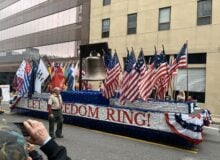
Our Cross Country adventure officially began with a warm send-off from Starr owners Sandy and Pete Borowsky, who gave a lovely speech and well-wishes for our journey. Before departing our final pick-up location, I played the National Anthem, and with that, we were on our way!
After reviewing the Starr Welcome Letter and watching the safety video, we met up with our nine Maryland travelers at Hoss’s, our lunch stop, bringing our group together as one party of 40.
To officially kick off our adventure, I played “America the Beautiful,” performed by Alicia Keys and Ray Charles, followed by Nat King Cole’s “(Get Your Kicks on) Route 66.” This provided the perfect introduction to a discussion about the history of Route 66. To bring that history to life, I followed the discussion with the classic 1940 film, “The Grapes of Wrath,” based on John Steinbeck’s novel. The film offered a fitting glimpse into life during the Great Depression of the 1930s and the hardships that shaped the story of Route 66.
The movie wrapped up just before we arrived at the Drury Inn in Grove City, Ohio. Everyone was looking forward to their first evening Kickback, a chance to unwind, share conversation, and get to know their newfound travel companions.
Today was the perfect first day of this wonderful journey. Sean put it best when he said, “We just completed our first 500 miles”.
Day 2: Monday, August 31, 2026
After a wonderful breakfast at the Drury Inn, we departed for Chicago!
As we traveled toward the Windy City, I played songs about Indiana and Chicago, and many guests sang along. I shared a brief history of Chicago and recommended a few must-try local favorites for our visit to Navy Pier: the Chicago-style hot dog, affectionately known as a “hot dog dragged through the garden,” an Italian beef sandwich, and the Billy Goat Tavern, immortalized by a classic “Saturday Night Live” skit.
Frank Sinatra’s “My Kind of Town” provided the perfect soundtrack as we rolled into downtown Chicago and arrived at Navy Pier. Everyone made the most of our two hours there! Many sampled the recommended Chicago specialties for lunch, while others strolled to the end of the pier to see the statue of comedian Bob Newhart. Some took a spin on the Centennial Wheel, and plenty of travelers left with bags of the city’s beloved Garrett Popcorn.
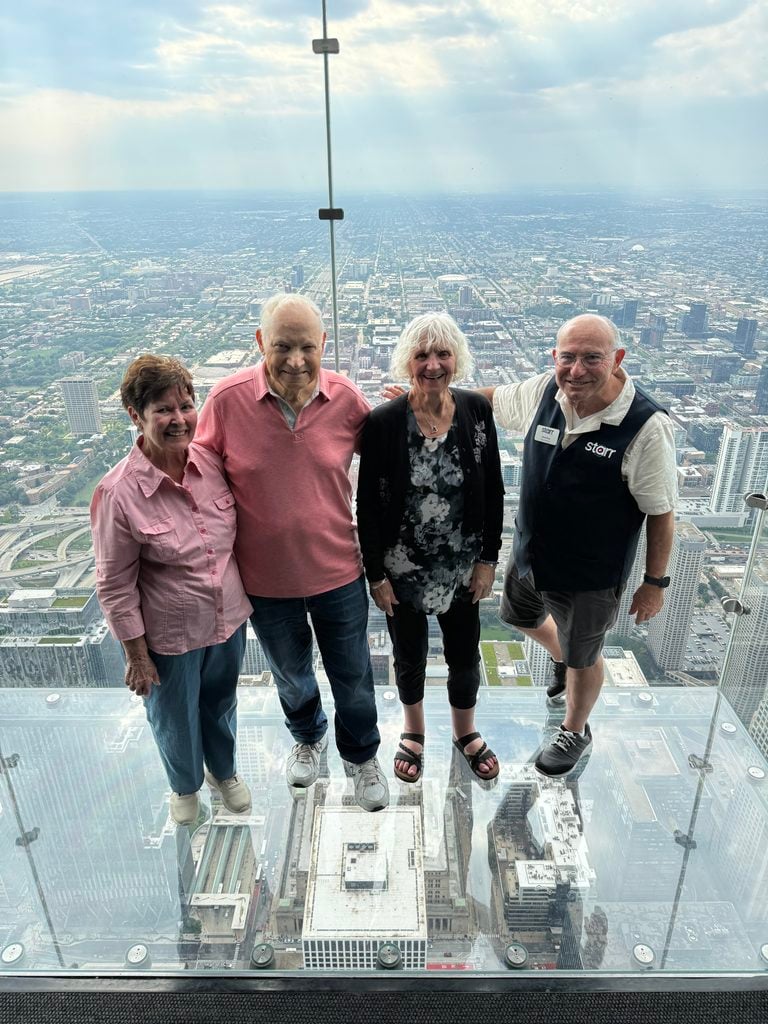
Next, we headed to the iconic Sears Tower, now Willis Tower, to explore the Skydeck and its exhibits. Many of us ventured onto The Ledge on the 103rd floor, stepping out onto glass-floored balconies for a thrilling view straight down to the streets below. On a clear day, you can see up to 50 miles. Others enjoyed the exhibits, posed with the simulated antennas representing the top of the building, and took photos with familiar Chicago faces, including Barack and Michelle Obama, Oprah Winfrey, and Michael Jordan.
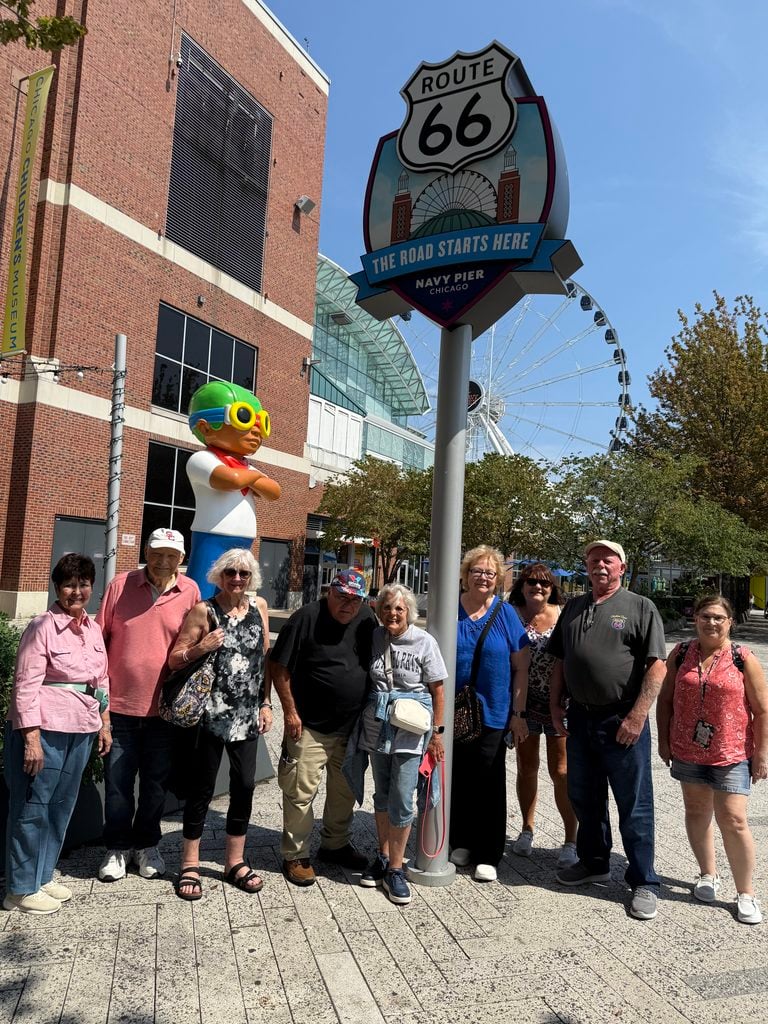
After checking into the Fairfield Inn, we walked to Giordano’s for dinner, where we received a warm welcome and were promptly seated upstairs. The family-style feast began with generous bowls of Caesar salad and penne pasta, followed by the pizzas: traditional thin crust, classic deep dish, and pepperoni deep dish. Brownies and freshly baked cookies capped off a plentiful, delicious meal.
We walked back to the hotel with nothing but good things to say about this marvelous city. Tomorrow, we begin to get our KICKS!
Day 3: Tuesday, September 1, 2026
We began our morning with a Wendella architectural boat cruise along the Chicago River. Our wonderful guide, Alissa, shared fascinating details about the unique and historic buildings we passed, and the towering skyscrapers lining the river made a stunning backdrop. Our guests thoroughly enjoyed it.
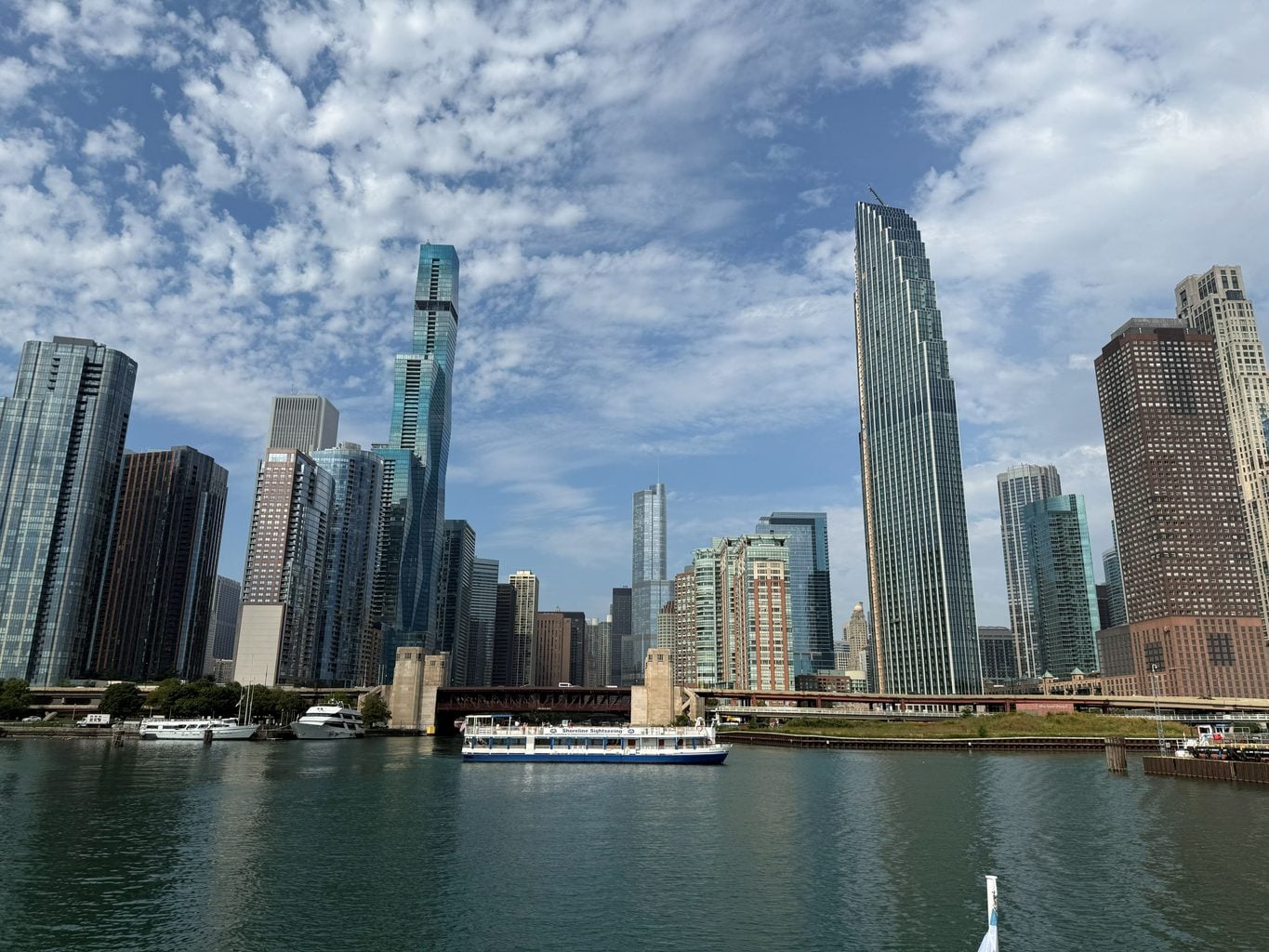
Afterward, Sean drove us to the “Begin Route 66” sign at Adams Street and South Michigan Avenue for a group photo. At Millennium Park, many walked to The Bean and marveled at its unique design. We then gathered at Manny’s Deli, a Chicago tradition, for a special Route 66 send-off luncheon.
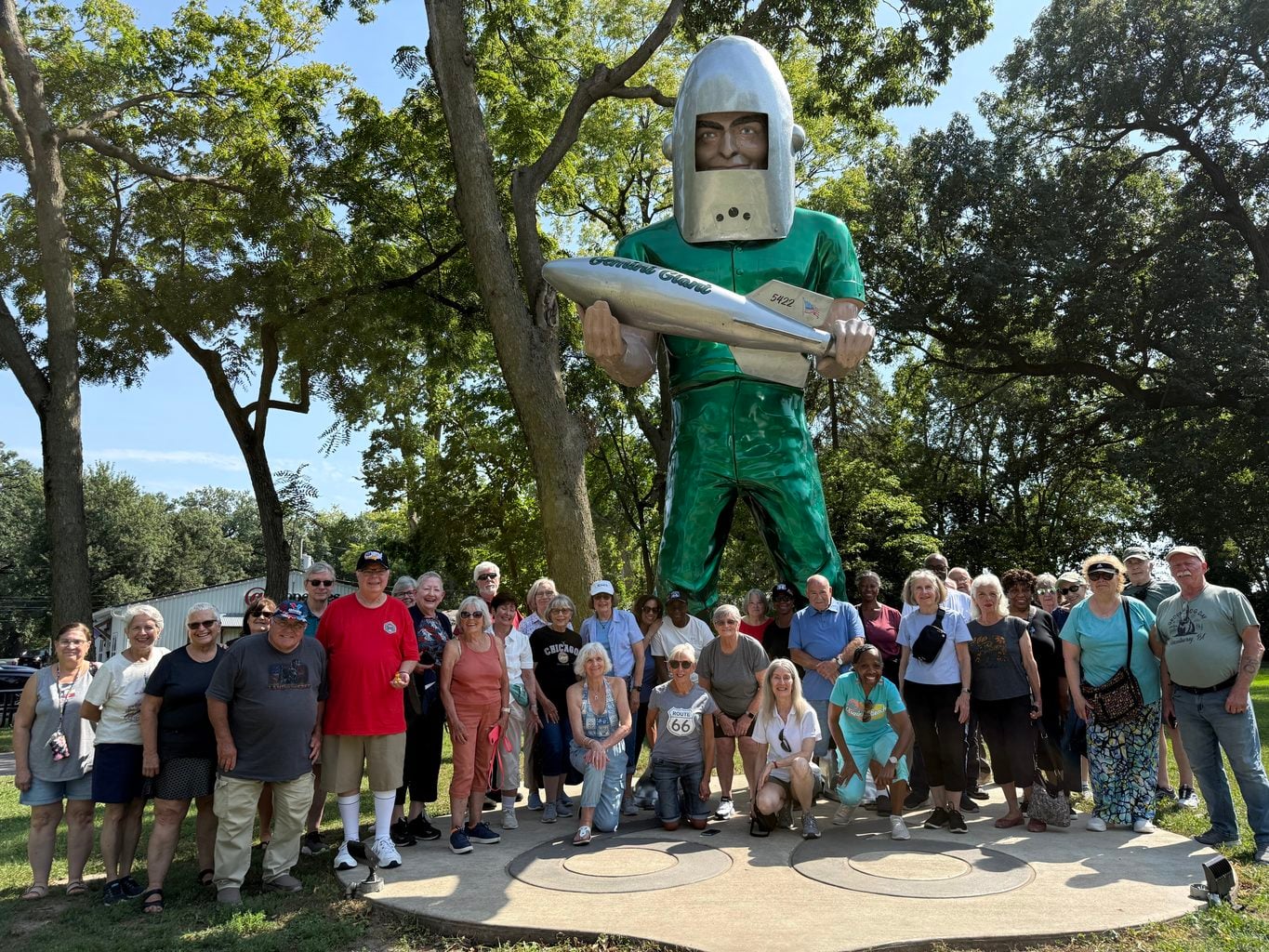
WE HAD OFFICIALLY BEGUN OUR JOURNEY ON ROUTE 66! Our first stop was the Gemini Giant, a towering “Muffler Man” in Wilmington, Illinois. Seeing this grinning giant smiling down on us took our breath away, and it was the perfect introduction to the quirky sights Route 66 has to offer.
Next, we visited the Ambler-Becker Texaco Gas Station in Dwight, fully restored and freshly painted for Route 66’s Centennial year. Our enthusiasm kept rising, right along with the temperature, which reached 95°!
Our final stop of the day was the Standard Oil Gas Station in Odell, Illinois, which operated as a service station through the 1970s. Beautifully restored to its 1940 appearance, it was easy to imagine Route 66 travelers pulling in for gas and auto repairs.
We concluded our third great day, and our first on Route 66, at the Hampton Inn in Pontiac, Illinois.
Day 4: Wednesday, September 2, 2026
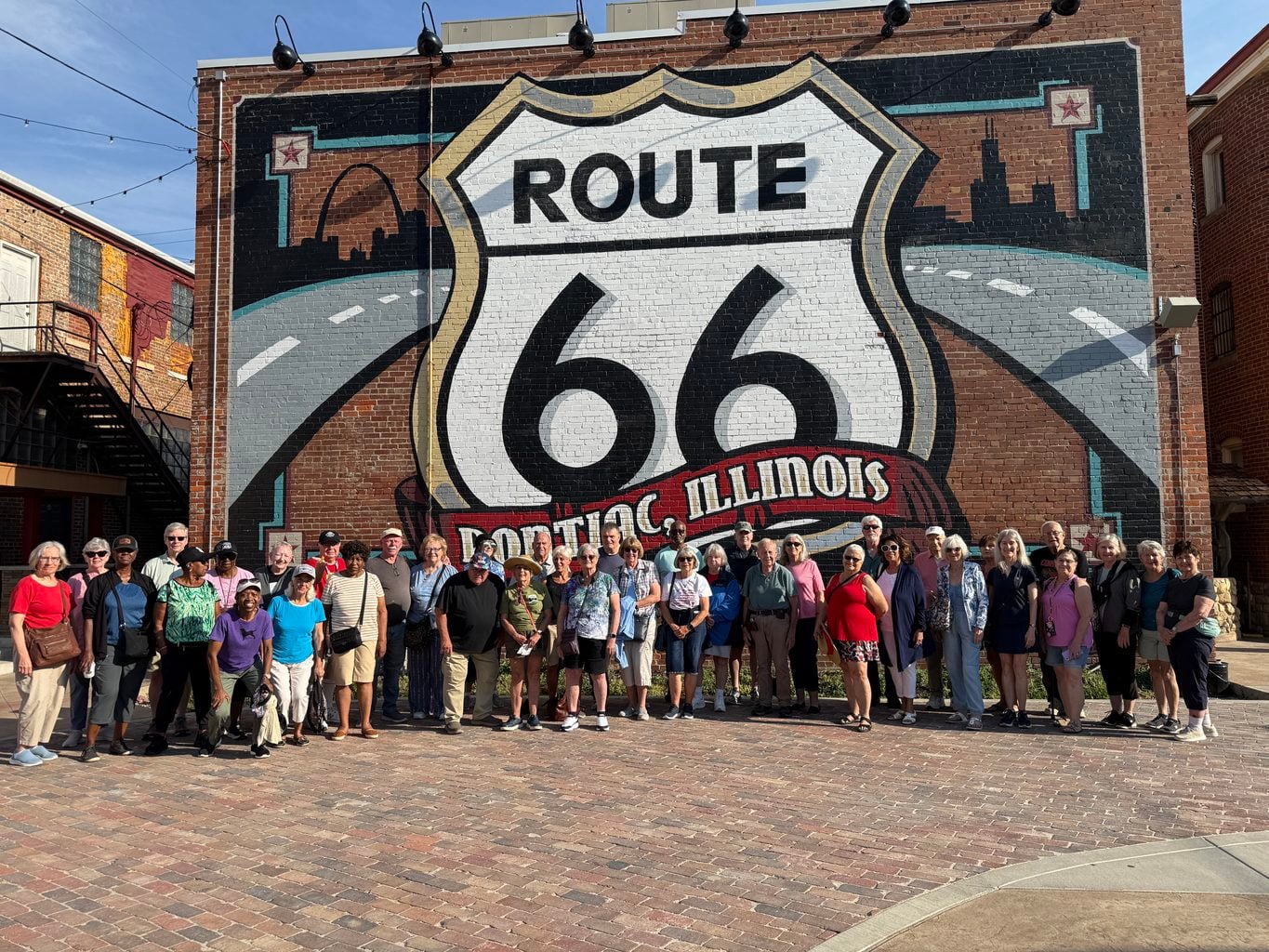
We began the day at the Route 66 Association Hall of Fame and Museum in Pontiac, snapping a group photo in front of the largest Route 66 mural in America. Inside, the first floor showcased Route 66 memorabilia, and the second recreated a 1940s and ’50s home, fully furnished from living room to bedroom. The third floor honored military history with nearly 300 uniformed mannequins representing every branch of the Armed Forces, each paired with the photo and biography of a Pontiac local who served. It was a fascinating tribute to the community.
Just a block away, many of our travelers visited the Pontiac Oakland Automobile Museum, home to pristine vintage cars dating back to the 1920s. Not surprisingly, they were all Pontiacs!
Next, we continued south on Route 66 to Funks Grove Pure Maple Sirup in Shirley, Illinois. Jeff, who married into the Funk family, told us the farm is among the southernmost maple syrup producers in the country, since maple trees need cold winters to produce sap. He also shared how climate change has affected the farm, with each year’s yield depending heavily on winter temperatures.
We then toured the building that houses the sirup-making equipment and were each treated to a taste of a special variety aged in a bourbon barrel. The Funks sell their sirup only through their Shirley store and by mail, and they typically sell out of their entire supply by early September. We were fortunate to be able to purchase up to a pint each!
Our Route 66 journey continued to McLean, Illinois, and the McLean Depot, now a model train store. We learned the depot’s history, and everyone received a stamped Route 66 stamp book as a special souvenir!
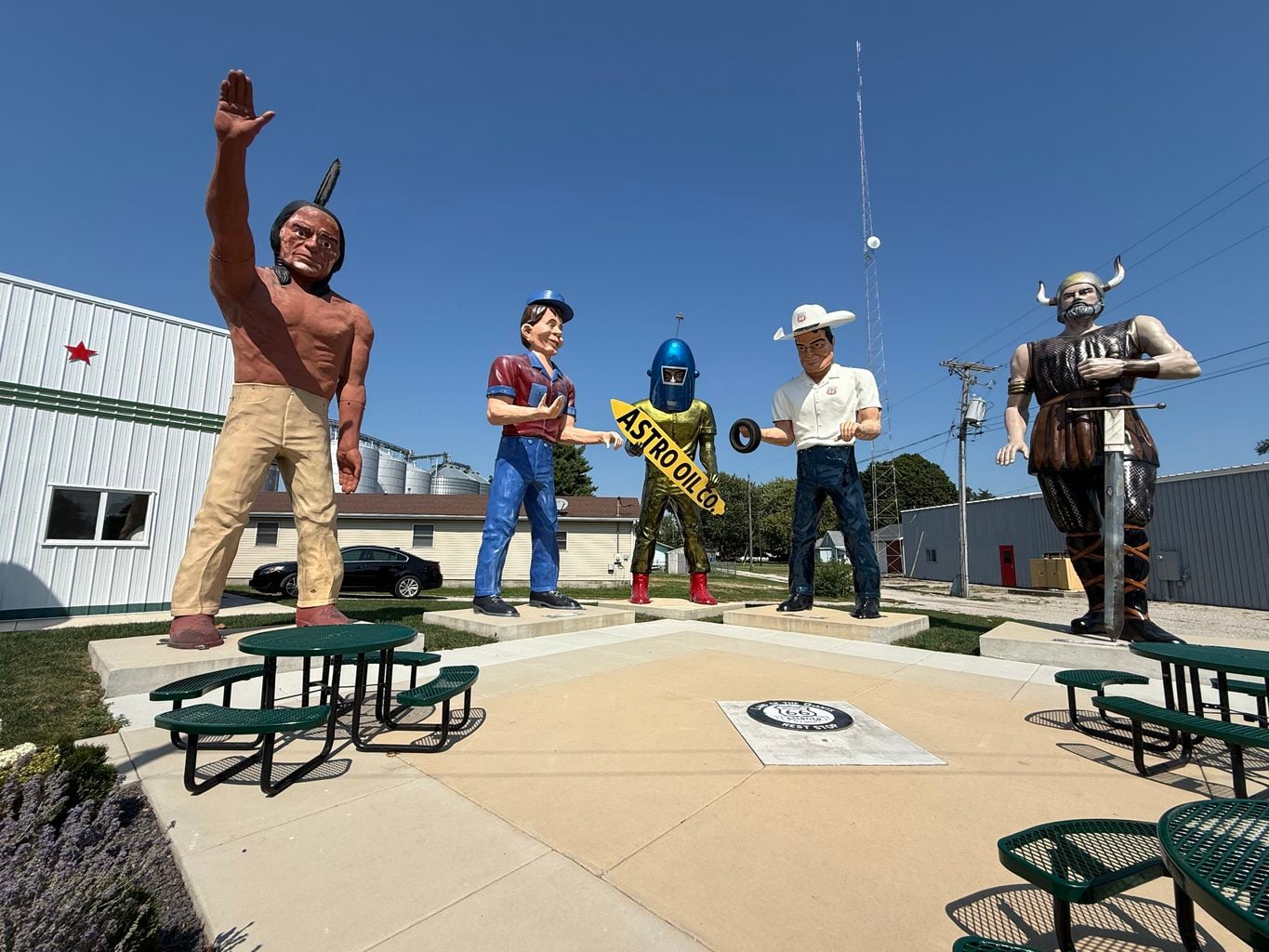
In Atlanta, Illinois, we saw some of Route 66’s most recognizable roadside attractions: the giant Muffler Men. Originally created to advertise businesses and lure travelers off the highway, these Giants of the Road have been lovingly gathered and restored by two dedicated collectors, who display them on concrete pedestals and inside two new museums. We saw Paul Bunyan holding a giant hot dog, Alfred E. Neuman of MAD Magazine, a Viking, and the Pep Boys. Around the corner, we visited Lumi, “The Server with a Pie,” the only female giant. Strolling these two blocks of whimsical art was a delight.
From there, we entered the “Land of Lincoln,” starting in Lincoln, Illinois. On August 27, 1853, at the first sale of town lots, Abraham Lincoln split a melon from a nearby wagon with his pocketknife, squeezed the juice into a tin cup, and poured it on the ground to christen the town, making it the first town named for him, years before he became president. We also saw the World’s Largest Covered Wagon, with Lincoln reading a law book atop a 25-foot covered wagon, in a small park honoring Lincoln and showcasing this impressive structure.
In Springfield, the state capital, we stopped at the Illinois State Fairgrounds to see the giant Rail Splitter statue of a young, beardless Lincoln holding a giant ax, erected in 1968 for the 150th anniversary of Illinois statehood.
By late afternoon, we checked into the Drury Inn in Springfield. As I handed out room keys, I told everyone to be at the Kickback at 6:00 PM for a surprise.
At 6:00 PM sharp, Abraham Lincoln walked through the door in his heavy overcoat and top hat and began greeting everyone. He graciously posed for pictures, answered questions, and shared his brilliance along with his quirky sense of humor. Asked to recite the Gettysburg Address, he delivered it with such passion that we were all teary-eyed, then noted that the speech was originally criticized for being too short. When asked about slavery, he spoke at length about the emotional, trying times of his presidency and his commitment to “All men are created equal.”
It was a fabulous 90 minutes being schooled by such a brilliant man, and a truly memorable end to an already fascinating day on Route 66!
Day 5: Thursday, September 3, 2026
This morning, we visited the Abraham Lincoln Presidential Museum in Springfield, where a friendly volunteer explained that the museum was designed by former Disney creative artists. It shows!
Our self-guided tour began with a holographic show built around the theme “What if ghosts could talk?” Lifelike figures told the story of Lincoln and the Civil War, building to a classic Disney-style finale that left us saying “WOW!” A second theater traced Lincoln’s life from boyhood to assassination on three screens, with seats that rumbled at every cannon blast.
The rest of the museum covers Lincoln’s early years and his presidency. We walked through a recreation of his log cabin and explored his early careers, key relationships, and growing opposition to slavery, all brought to life in vivid, larger-than-life dioramas. The White House section focused on the Civil War, from newspaper cartoons ridiculing Lincoln to powerful exhibits drawn from Illinois soldiers’ firsthand accounts. The tour ended solemnly at Lincoln’s closed casket, a moving conclusion to an unforgettable experience.
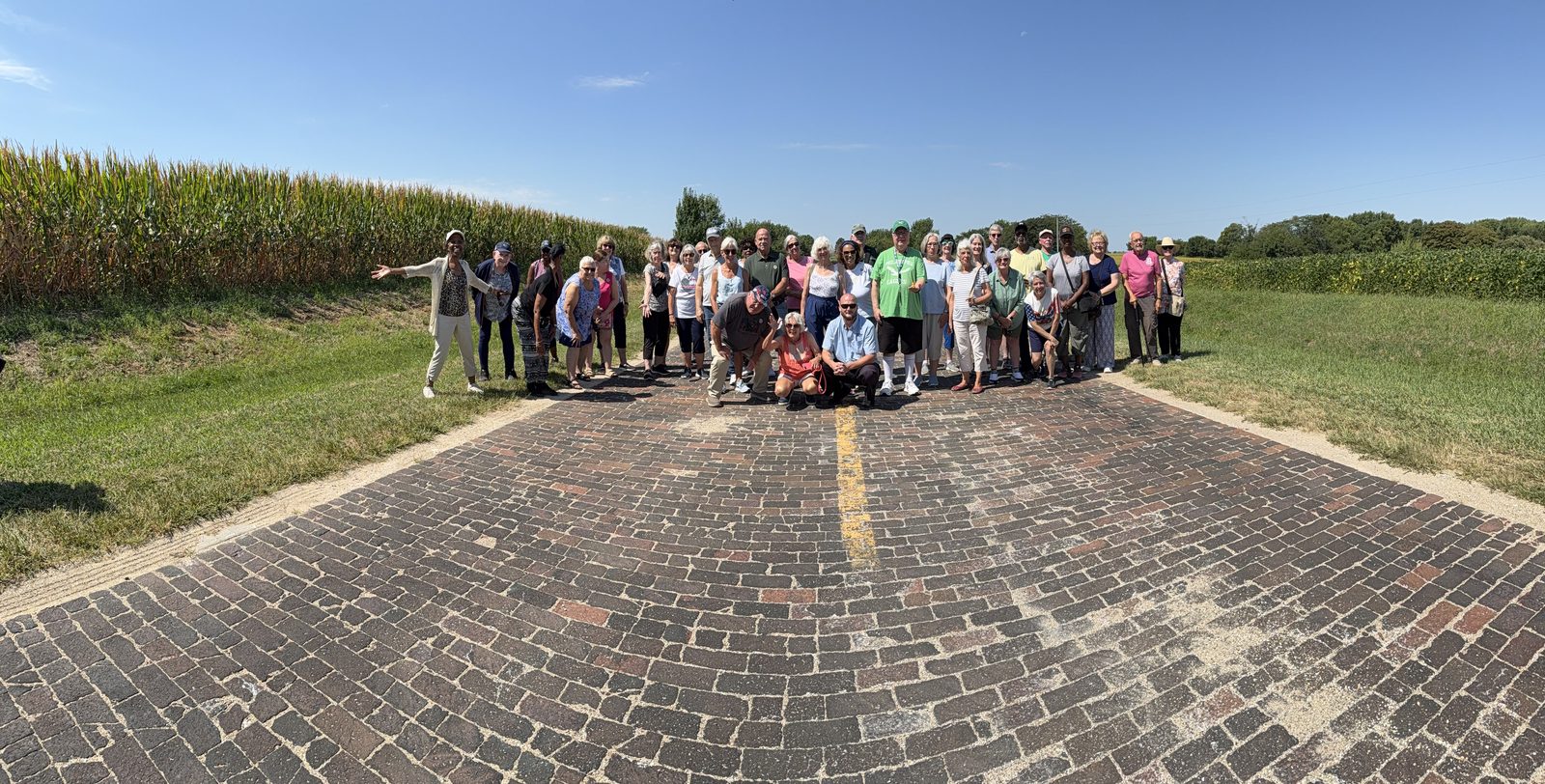
We continued along Route 66 to the historic Brick Road, an original stretch of the highway and one of its most distinctive surviving sections. With corn on one side and soybeans on the other, the rural setting was beautiful, and rolling along the bricks gave us a fun glimpse into the early days of Route 66.
Lunch was at Doc’s on Route 66 in Girard, Illinois. Doc’s dates back to 1884, when it operated as an apothecary dispensing remedies that contained cocaine and even arsenic. In the 1920s, a soda fountain and restaurant were added to serve Route 66 travelers. Doc’s is famous for its phosphates, effervescent drinks with your choice of flavoring, and we thoroughly enjoyed both our lunch and the old-time atmosphere.
Heading west toward Missouri, I showed the History Channel’s documentary “The St. Louis Arch”, which traced the landmark from concept to completion with live footage and interviews. It was an excellent introduction to tomorrow morning’s visit.
Before crossing the Mississippi River, we stopped in Collinsville, Illinois, at the World’s Largest Catsup Bottle. Rising 170 feet above the ground, it was built to advertise Brooks Catsup, once produced at the factory below. Although production has since moved to Indiana, the giant bottle remains a beloved roadside attraction welcoming Route 66 travelers.
We then crossed the mighty Mississippi into St. Louis, where the Gateway Arch, the “Gateway to the West,” gave us a spectacular welcome. We checked into our hotel before setting out to explore downtown.
Having visited this part of St. Louis many times, I led our group on a walking tour of downtown. We strolled up Market Street past the Old Courthouse, taking in two parks and a host of statues and monuments along the way. First came the Runners Statue, dedicated to Kiemer, an athlete in the 1904 Olympics held right here in St. Louis. Next was Citygarden, a two-block park filled with quirky, whimsical art, including a giant comb, a zipper sprawled across the ground, Pinocchio with his long nose, and a pink headless suit standing at attention.
Farther along Market Street, we paused at a moving memorial honoring enslaved people who were denied their freedom in Missouri before the Civil War. Our final stop was the very first statue of Ulysses S. Grant, the president and longtime St. Louis resident, standing tall in front of City Hall. Our guests loved exploring the city on foot, and we strolled back to the Drury Inn just in time for the Kickback.
Day 6: Friday, September 4, 2026
After breakfast, we walked across the street to Gateway Arch National Park and rode the tram to the top of the Arch. On this clear, sunny day, we could see for thirty miles in every direction: the Mississippi River and Illinois on one side, and the Old Courthouse, Busch Stadium (home of the St. Louis Cardinals), and the St. Louis skyline on the other. Back on the ground, some guests browsed the gift shop while others explored the museum, which covers early St. Louis history, westward expansion by covered wagon in the 1840s, and American artifacts spanning the 18th to 21st centuries.
We then headed to Wildwood, Missouri, for lunch at the Big Chief Roadhouse, a Route 66 landmark dating to 1928. Built in the Spanish Mission Revival style, it was envisioned as part of a chain of full-service roadside stops.
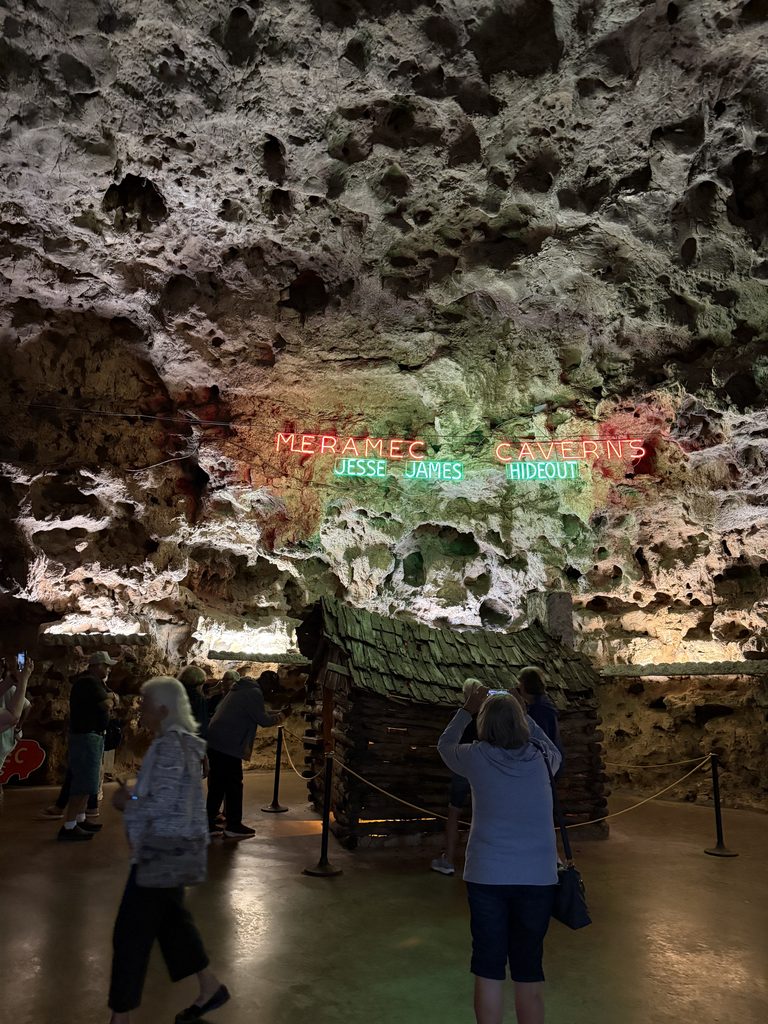
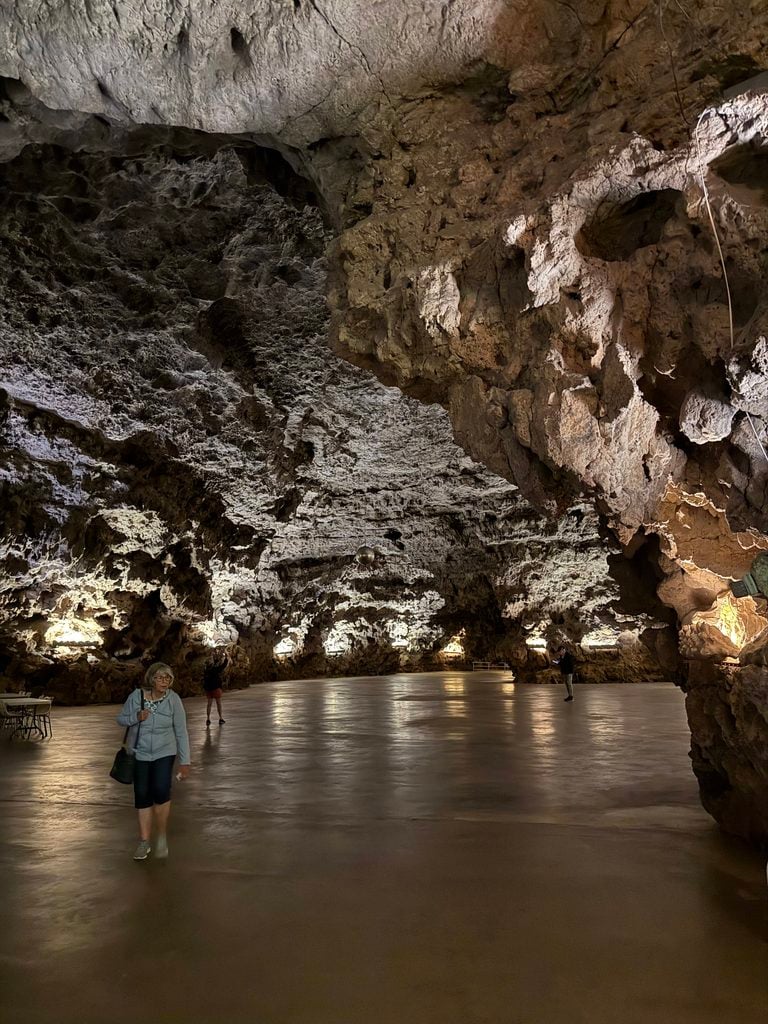
Continuing on Route 66 and I-44, we reached Stanton, Missouri, and Meramec Caverns, famous as a hideout for outlaws Jesse and Frank James. A short, guided tour took us into the cave’s largest chamber, the Ballroom, where the constant 55° temperature was a refreshing break from the heat.
In Cuba, Missouri, we stopped at the historic Wagon Wheel Motel. Robert and Margaret Martin bought the land in 1934 and opened the Wagon Wheel Cabins, complete with a café and filling station. We toured one of the rooms, now updated with a jacuzzi bath and queen bed.
A few miles down the road in Fanning, we marveled at the World’s Second Largest Rocking Chair, a 25-foot metal giant that certainly made an impression!
Our last stop was a photo op in Springfield, Missouri, at the Best Western Rail Haven. Opened in May 1938 by brothers Lawrence and Elwyn Lippman as the Rail Haven Motor Court, it joined the newly formed Best Western chain in 1948. Its most famous guest was Elvis Presley, who stayed in Room 409 on May 17, 1956, and in tribute to the King, the bed in his room has since been transformed into a Corvette!
We spent the night in Springfield, MO.
Day 7: Saturday, September 5, 2026
We began at Fantastic Caverns, the only cave in North America, and one of only a few in the world, toured entirely by Jeep-drawn trams. In 1862, farmer John Knox’s bloodhound chased an animal into a hole in the hillside, revealing the cave. In 1867, Knox advertised for explorers, and twelve women from the Springfield Athletic Club answered. Armed with ropes, torches, and lanterns, they crawled through the passages and carved their names into the walls, where they remain today. Propane-powered Jeeps arrived in the 1960s, and today’s filtered vehicles protect the cave’s air and ecosystem. Our guests loved the hour-long ride past colorful stalagmites, stalactites, and columns.
Back on the motorcoach, I played the documentary “Mickey Mantle” ahead of our visit to his hometown later in the day. We stopped at the Route 66 Drive-In Theatre in Carthage, one of the few drive-ins still operating on the Mother Road, then enjoyed lunch at Iggy’s Diner before making our last Missouri stop at Bonnie and Clyde’s garage hideout in Joplin.
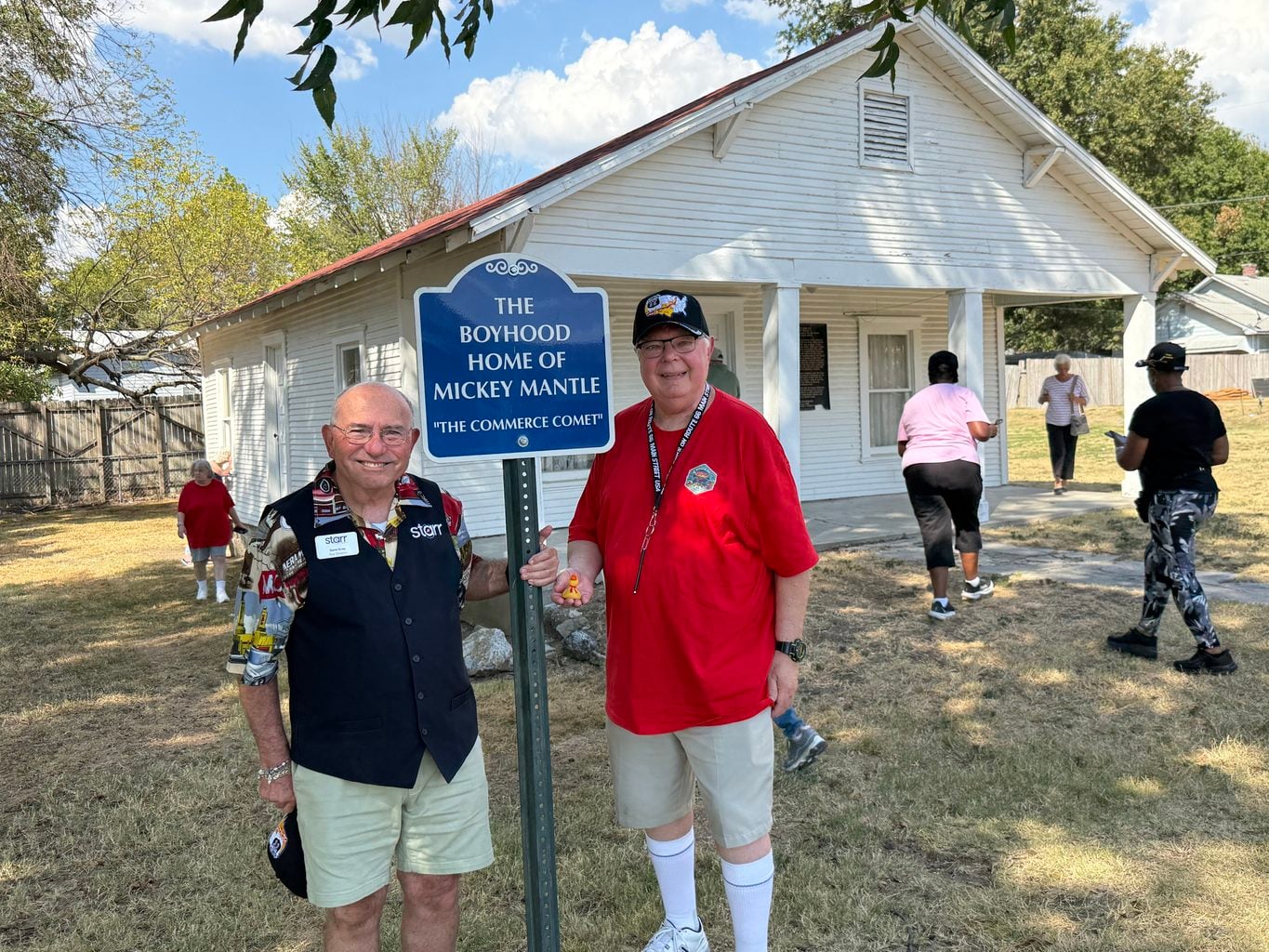
Kansas has the shortest stretch of Route 66 among its eight states. In Galena, Tow Mater and friends from Pixar’s “Cars” greeted us at the Kan-O-Tex Service Station, which helped inspire the 2006 film. In Riverton, Nelson’s Old Riverton Store, built in 1925 and listed on the National Register of Historic Places, still boasts its original glass-enclosed porches and pressed-tin ceilings. Owner Scott Nelson happily chats with visitors and rings up sales on a 1950s cash register in the half-deli, half-gift shop. Our final Kansas stop was the graceful white Rainbow Bridge over Brush Creek, the last of its kind on Route 66.
We crossed into Oklahoma to the song of the same name and headed to Commerce, Mickey Mantle’s hometown. At his boyhood home, we saw the dented metal barn he hit baseballs against as a boy, and at Commerce High School, a statue of his famous swing honors “The Commerce Comet.”
We spent the night in Vinita, Oklahoma.
Day 8: Sunday, September 6, 2026
Our driver, Sean, had the day off, so we waved goodbye and set off with Sonny of Village Travel for Ed Galloway’s Totem Pole Park in Chelsea, Oklahoma.
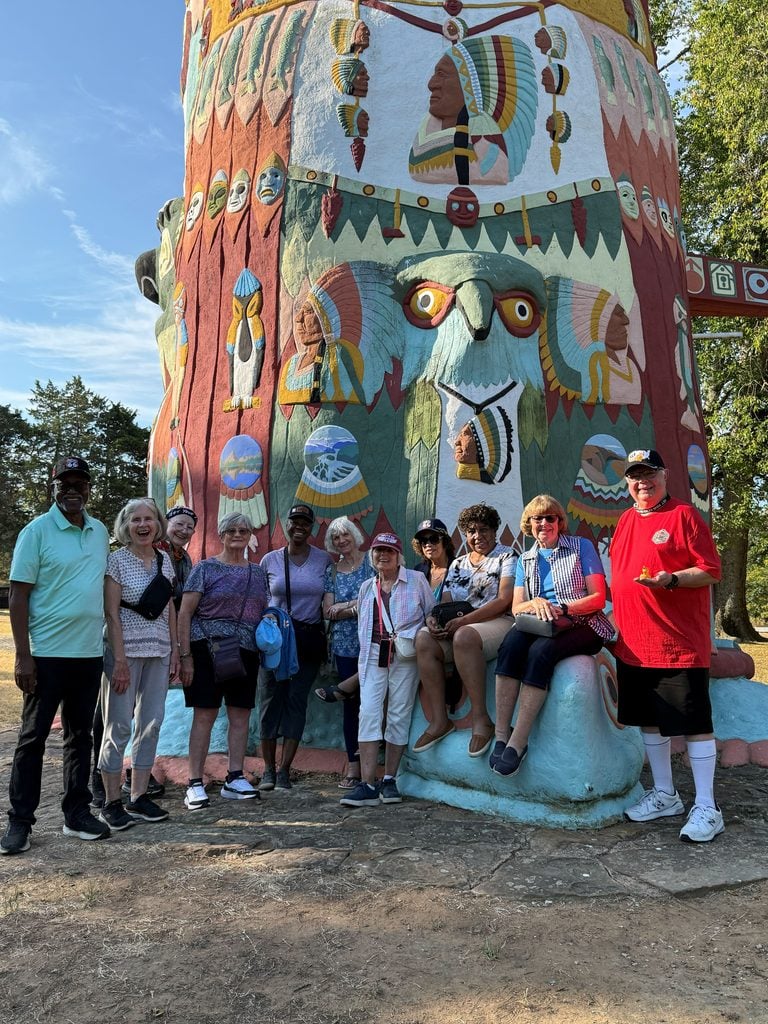
Ed Galloway was a folk artist and woodworking instructor who, after serving in the U.S. Army, spent more than two decades teaching woodworking to orphan boys at the Sand Springs Home. When he retired here in 1937, he devoted the rest of his life, until his death in 1962, to building totem poles and wooden violins. His masterpiece, the World’s Largest Concrete Totem Pole, rises 90 feet from the back of a giant concrete turtle. Built between 1937 and 1948, it took 28 tons of cement, 6 tons of steel, and 100 tons of sand and rock. Smaller, equally colorful totem poles dot the park, and Ed’s 11-sided workshop now serves as a gift shop displaying his beautiful violins. Everyone loved it.
In Claremore, we visited the Will Rogers Museum, where trick-roping cowboy and Will Rogers expert Brad led us into the theater. Twirling ropes, and even jumping through his larger loops, he told the life story of his hero without missing a beat. Brad performs at hundreds of schools a year to keep Rogers’ legacy alive, fitting for a man whose name graces Route 66’s official nickname, “The Will Rogers Highway.”
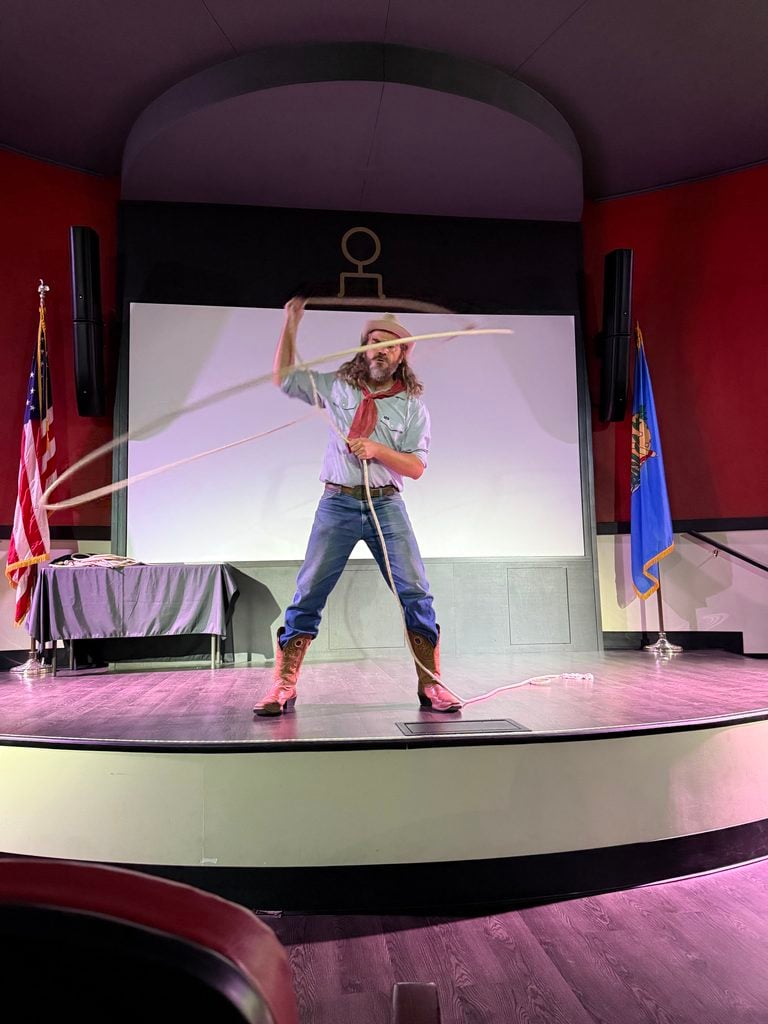
Born in 1879 in the Cherokee Nation, Rogers was of Cherokee descent on both sides and loved to joke, “My ancestors didn’t come over on the Mayflower, but they were at the pier to meet ’em.” He became a vaudeville star with his rope tricks and wit, then a radio personality, newspaper columnist, and star of both silent and talking films. He traveled constantly, was beloved wherever he went, and is best remembered for his famous line, “I never met a man I didn’t like.”
After lunch around the corner at the Hammett House, we visited the Blue Whale of Catoosa, one of Route 66’s quirkiest and most beloved attractions. Hugh Davis, a zoologist and director of the Tulsa Zoo, built the 80-foot-long, 20-foot-high waterfront whale as an anniversary gift for his wife, Zelta, who collected whale figurines. It quickly became a favorite stop for Route 66 travelers. A new visitors center with indoor seating, a gift shop, and restrooms opened in 2026, and the freshly painted whale is still smiling and brightening everyone’s day!
At the Woody Guthrie Center in Tulsa, a 13-minute introductory film set the stage before we explored exhibits on Woody’s songwriting, artistry, and belief that all people deserve dignity and respect. Born Woodrow Wilson Guthrie on July 14, 1912, in Okemah, Oklahoma, he was named for Woodrow Wilson, who won the Democratic presidential nomination that same month. During the Great Depression, Guthrie joined the “Okies” fleeing the Dust Bowl for California, an experience that shaped his songs about working-class struggles. He wrote hundreds of folk, political, and children’s songs, most famously “This Land Is Your Land,” composed in 1940 as a response to Irving Berlin’s “God Bless America.” His guitars famously bore the slogan “This machine kills fascists,” and his music passionately championed ordinary Americans and a fairer share of the nation’s wealth.
Two blocks away sat the Center of the Universe, and a few brave guests endured 104° heat to walk up to it. We then stopped at Cyrus Avery Centennial Plaza to photograph the striking “East Meets West” statue.
Known as “The Father of Route 66,” Cyrus Avery championed a paved highway linking Chicago and Los Angeles in 1925 and served on the federal board that planned the U.S. Numbered Highway System, which made Route 66 official on November 11, 1926. The statue shows Avery and his family in a Model T meeting a horse-drawn wagon, its horses rearing in alarm at the car.
We spent the night in Tulsa.
Day 9: Monday, September 7, 2026
We reunited with our driver, Sean, and began the day at the Circle Cinema Walk of Fame. Tulsa’s oldest remaining cinema, the Circle opened on July 15, 1928, as a single-screen silent movie house showing “Across the Pacific.” After closing in the mid-1990s, it was purchased by the Circle Cinema Foundation in 2002 and reopened in 2004 as a nonprofit arthouse. Today, it screens independent, documentary, foreign, and local films and features an art gallery and a restored 1928 Robert Morton pipe organ. Brass medallions on the sidewalk out front honor Oklahomans who made their mark in entertainment, including Will Rogers, Gene Autry, Chuck Norris, Reba McEntire, and Kristin Chenoweth.
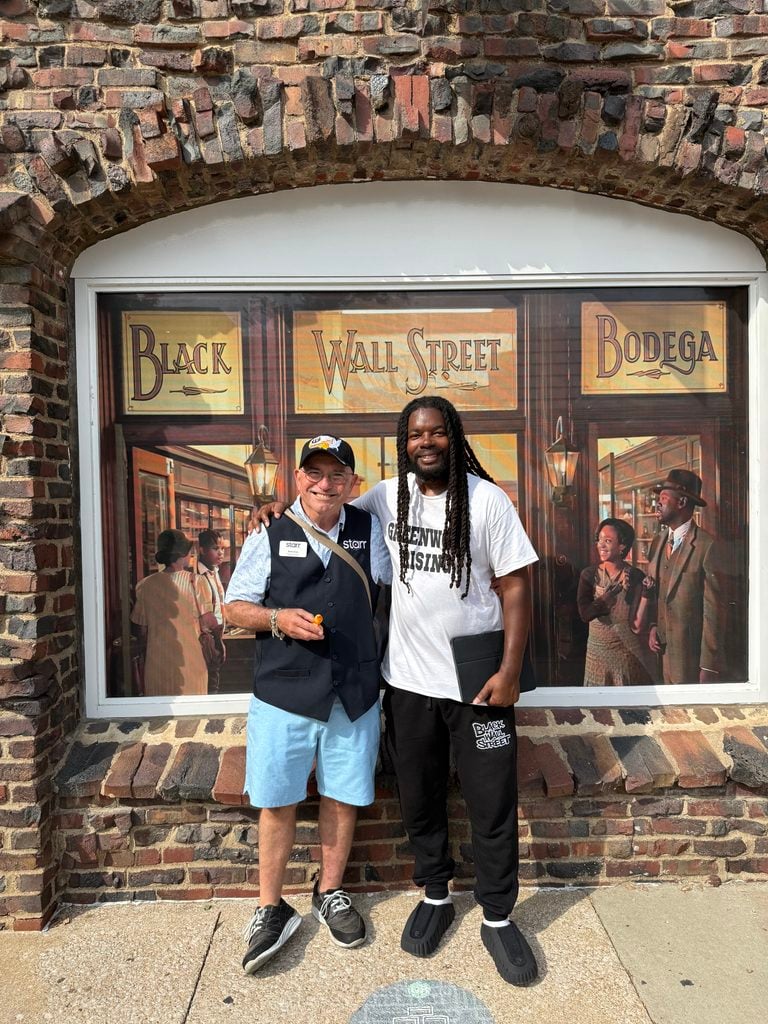
In Tulsa’s Greenwood district, our guide, Kode, met us at the motorcoach and recounted the events leading up to May 31, 1921. Long labeled the Greenwood “Riot,” it is now officially recognized as the Tulsa Race Massacre, and the city has formally apologized. Kode explained that calling it a riot allowed insurance companies to avoid paying for the damages, leaving many who had lost homes, loved ones, and livelihoods with nothing. As we walked two blocks down Greenwood Avenue, he pointed out the church that survived the attack, the sites of theaters and businesses that were burned to the ground, a mural rich with symbols of Black culture, and monuments to the people and businesses lost from Black Wall Street. Kode was magnificent, and the tour was real, emotional, and shocking. We experienced a piece of history that must never be forgotten, so it will never be repeated.
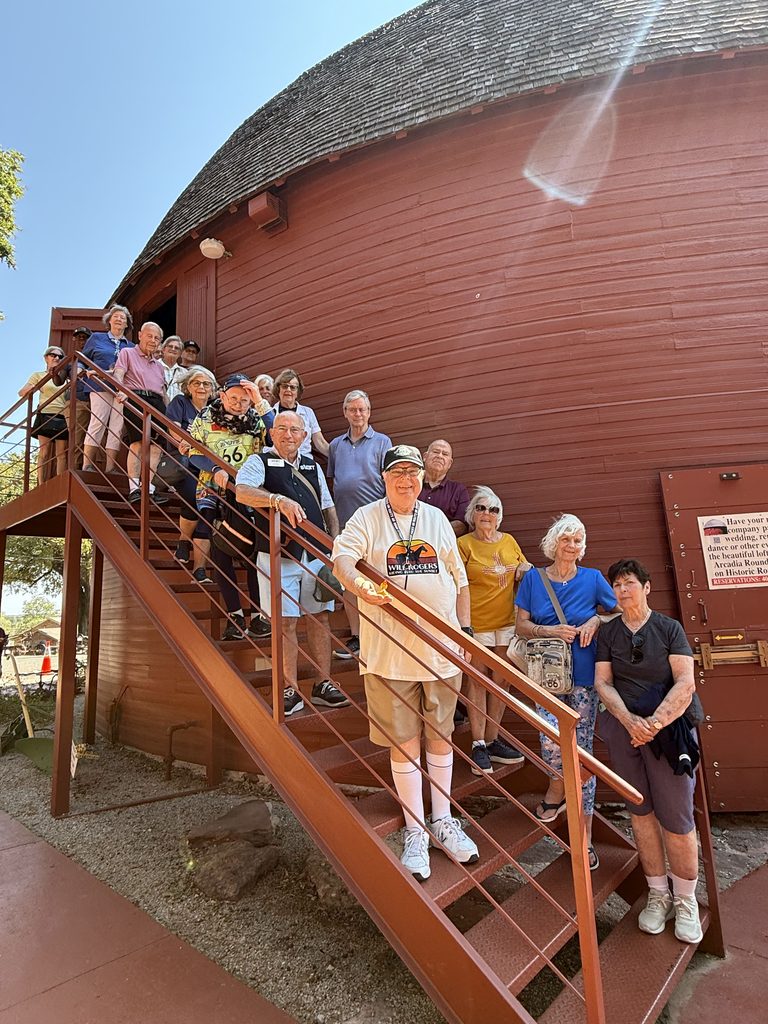
An hour later, we arrived in Arcadia at the Round Barn, where events coordinator Andrea shared its history. Local farmer William Harrison Odor built the barn in 1898, soaking fresh green oak boards and bending them into curved rafters to create its distinctive cylindrical shape and domed roof. The lower level originally housed livestock and hay, while the open upper floor hosted dances and community events. Today, the lower level is a museum and gift shop, and the upper floor still holds dances twice a month.
Just up the road, we stopped at POPS 66, an iconic Route 66 restaurant selling more than 700 varieties of bottled soda.
We then made an unplanned stop that turned out to be a highlight: the Threatt Filling Station. Allen Threatt Sr., an African American homesteader from Alabama, established a 160-acre farm here and in 1915 opened a modest filling station on what was then State Highway 7. When the road became U.S. Route 66 in 1926, the station became an essential stop for cross-country travelers. After fire destroyed the original wooden structure, the family rebuilt around 1933 with sandstone quarried from their own land, and that sturdy building still stands. Threatt’s offered gas, oil, repairs, cold drinks, groceries, and fresh produce from the family farm. Because many hotels refused service to Black motorists, the family let travelers park safely behind the station to sleep in their cars. The station was added to the National Register of Historic Places in 1995.
In Edmond, retired teacher Judy Pike welcomed us into the 1889 Territorial Schoolhouse. A giant stove that burned cow chips stood in the center of the room, flanked by two original 1889 blackboards, recently rediscovered and now encased in plexiglass. Judy shared how 150 settlers staked claims in Edmond during the 1889 Land Run and described the teachers, who were mostly 16 to 21 years old, couldn’t date or marry, and earned $75 a month. Students ages 6 to about 14 learned together, with the youngest seated up front in wooden desks. Judy was knowledgeable and delightful, and everyone enjoyed stepping back in time.
In Oklahoma City, we snapped photos of the Milk Bottle Grocery, a tiny 350-square-foot triangular brick building on Route 66. Originally a deli, it earned its name when a giant milk bottle was added to the roof as advertising in 1948. We then visited the Oklahoma City National Memorial to pay our respects to the victims of the 1995 bombing of the Alfred P. Murrah Federal Building.
We spent the night in Oklahoma City.
Day 10: Tuesday, September 8, 2026
We began at the Oklahoma Route 66 Museum in Clinton, where exhibits bring the Mother Road’s history to life. Life-sized displays recreate a mechanic’s shop, a family packing their car for the journey, and a soda fountain, alongside a 1951 Ford. Vintage newspaper articles, a quilt featuring Route 66 attractions, and photos from yesteryear line the walls.
Lunch at Lucille’s Route 66 Roadhouse marked our final Route 66 stop in Oklahoma.
Crossing into Texas, we arrived in Shamrock at the famous Tower Conoco Station and U-Drop Inn Café, an Art Deco icon that was once the only place to fuel up and grab a meal for 100 miles. The station is closed, but the striking building still stands in all its glory, and the gift shop next door sells Route 66 memorabilia.
In McLean, the Devil’s Rope Museum told the story of how barbed wire helped settle the West and showcased art crafted from it. A room devoted to Route 66 in Texas features the original cow from the Big Texan Steak Ranch on a pedestal at its center, while the Dust Bowl Room displays remarkable, rarely seen photos of the devastating storms that swept the Texas Panhandle in 1935.
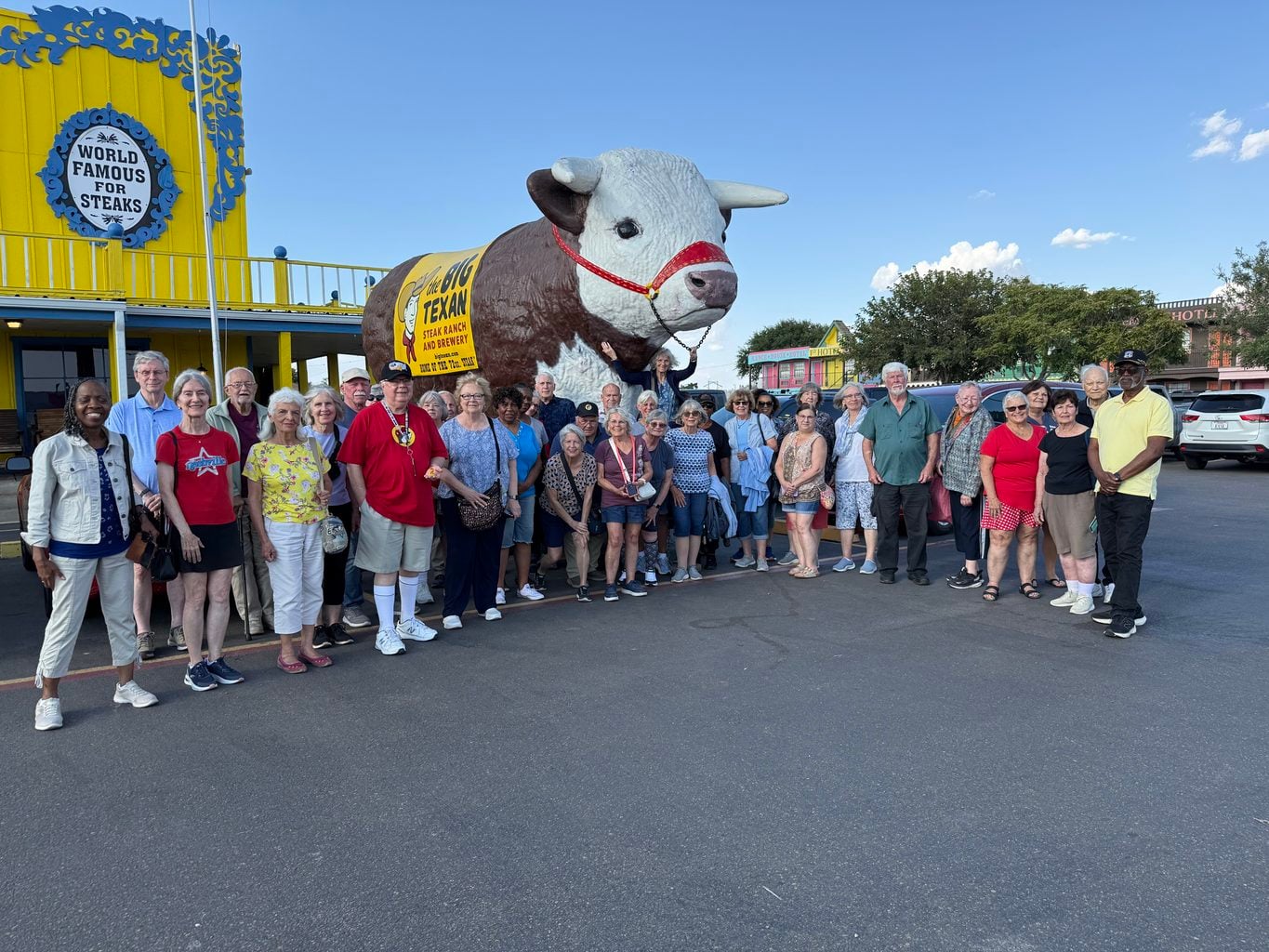
Heading west on I-40/Route 66, we pulled off in Groom for a photo of the Britten Leaning Tower before arriving in Amarillo. Dinner at the iconic Big Texan Steak Ranch was a feast everyone enjoyed!
Day 11: Wednesday, September 9, 2026
We began the day at Cadillac Ranch, just west of Amarillo. Created in 1974, it features ten Cadillacs from 1949 to 1963, lined up in chronological order to show the evolution of the iconic tail fin. The cars are buried nose-first, facing west, at an angle said to match the Great Pyramid of Giza. Many guests grabbed a can of spray paint to add their own mark, and everyone enjoyed this quirky Route 66 stop.
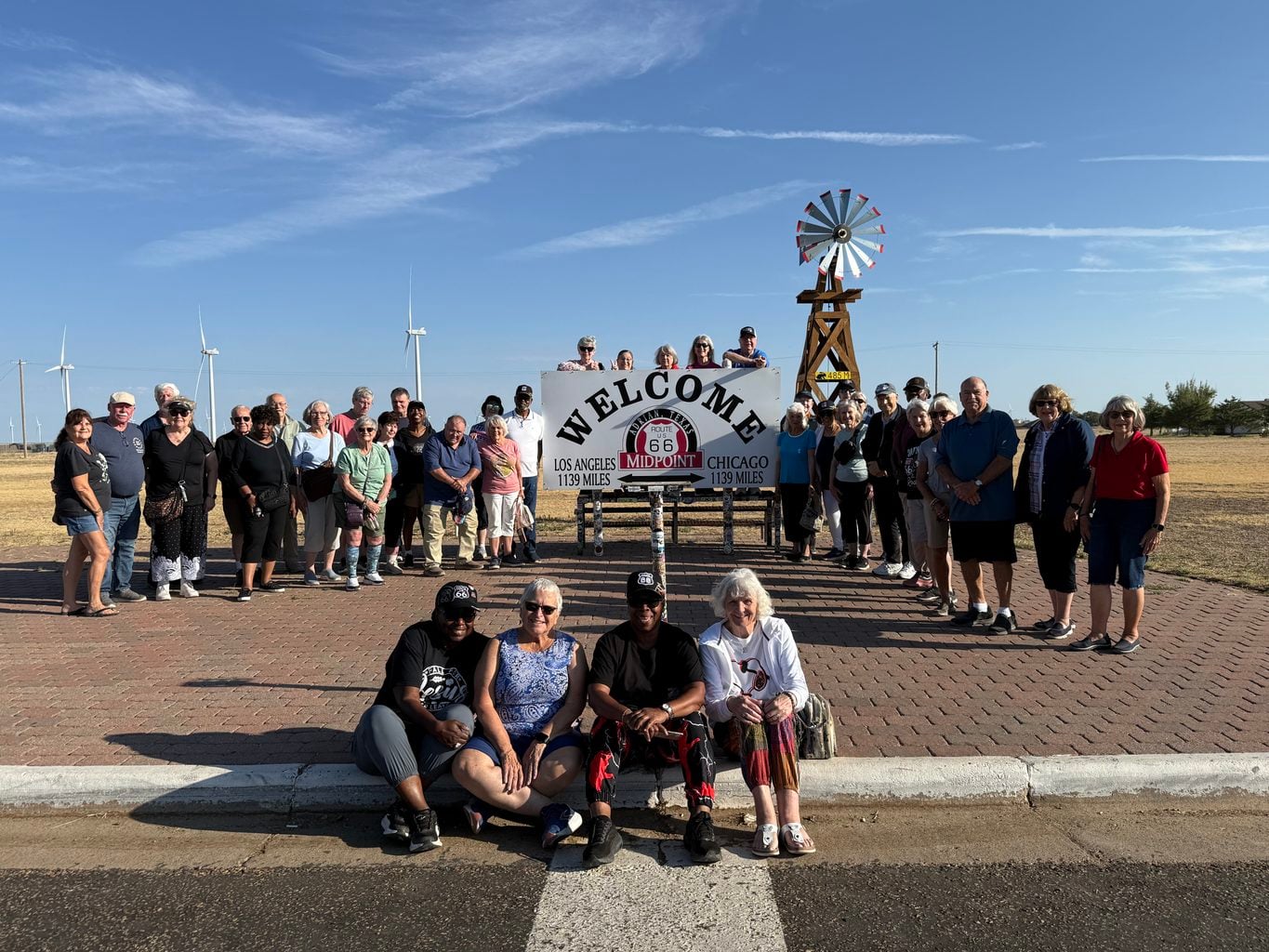
Our final Texas stop was a very important one: the Midpoint Cafe in Adrian, exactly 1,139 miles from both Chicago and Los Angeles. Freshly made cinnamon buns and hot coffee were waiting for us inside. It was hard to believe we were already halfway!
Just across the New Mexico line, we visited a Route 66 museum filled with collectibles from Elvis, Marilyn Monroe, The Beatles, and more. The museum was set to close permanently on October 1, 2026, with most of its valuable artifacts auctioned off online, so we were lucky to see it.
In Tucumcari, owner Robert welcomed us to the historic Blue Swallow Motel. Opened in 1940 with eight rooms, each with its own garage for Route 66 travelers, it now has 12 rooms ranging from $129 to $149 a night. We toured a room furnished in 1940s decor, right down to the dial telephone on the nightstand.
Two minutes away, owners Donna and her husband closed SideKix on 66 to locals and opened the doors just for us. Lunch was delicious!
After browsing Teepee Curios, a classic Route 66 gift shop, we posed for photos at the iconic Route 66 sign at the Tucumcari Convention Center. Back on the motorcoach, we drove through Tucumcari’s faded stretch, lined with abandoned motels, filling stations with rusting vehicles, crumbling homes, and boarded-up storefronts.
On the way to Albuquerque, I played “The Founder”, starring Michael Keaton as Ray Kroc, to set the stage for our upcoming visit to the original McDonald’s site in San Bernardino. The film tells how Kroc legally wrested McDonald’s away from the McDonald brothers, and everyone watched with great interest.
We spent the night in Albuquerque.
Day 12: Thursday, September 10, 2026
Our first stop was the Sandia Peak Tramway. Under cloudless skies, we could see 80 miles in every direction. From the 10,378-foot summit, Albuquerque sprawled tiny below us, with desert, distant towns, and mountains stretching to the horizon in vibrant, ever-changing colors. The views were breathtaking both on the ride and at the top.
In Old Town Albuquerque, many guests used the map and lunch suggestions I provided to explore shops as unique as the Spanish architecture that gives the district its special flair.
Before leaving town, we stopped at the iconic KiMo Theatre on Route 66. Opened in 1927 by Italian entrepreneur Oreste Bachechi, it brought Hollywood to Albuquerque with Al Jolson’s first talkies, the latest films, vaudeville acts, and plays. Still going strong today, it’s one of the city’s most treasured historic venues.
Heading west, the desert put on a show of rich colors, parched land, and mountains. We crossed the Continental Divide and arrived at the trip’s most anticipated rest stop, the Navajo store at Love’s in Gallup. Guests snapped up dozens of $4.99 Mexican blankets, and many treated themselves to a $1 ice cream cone.
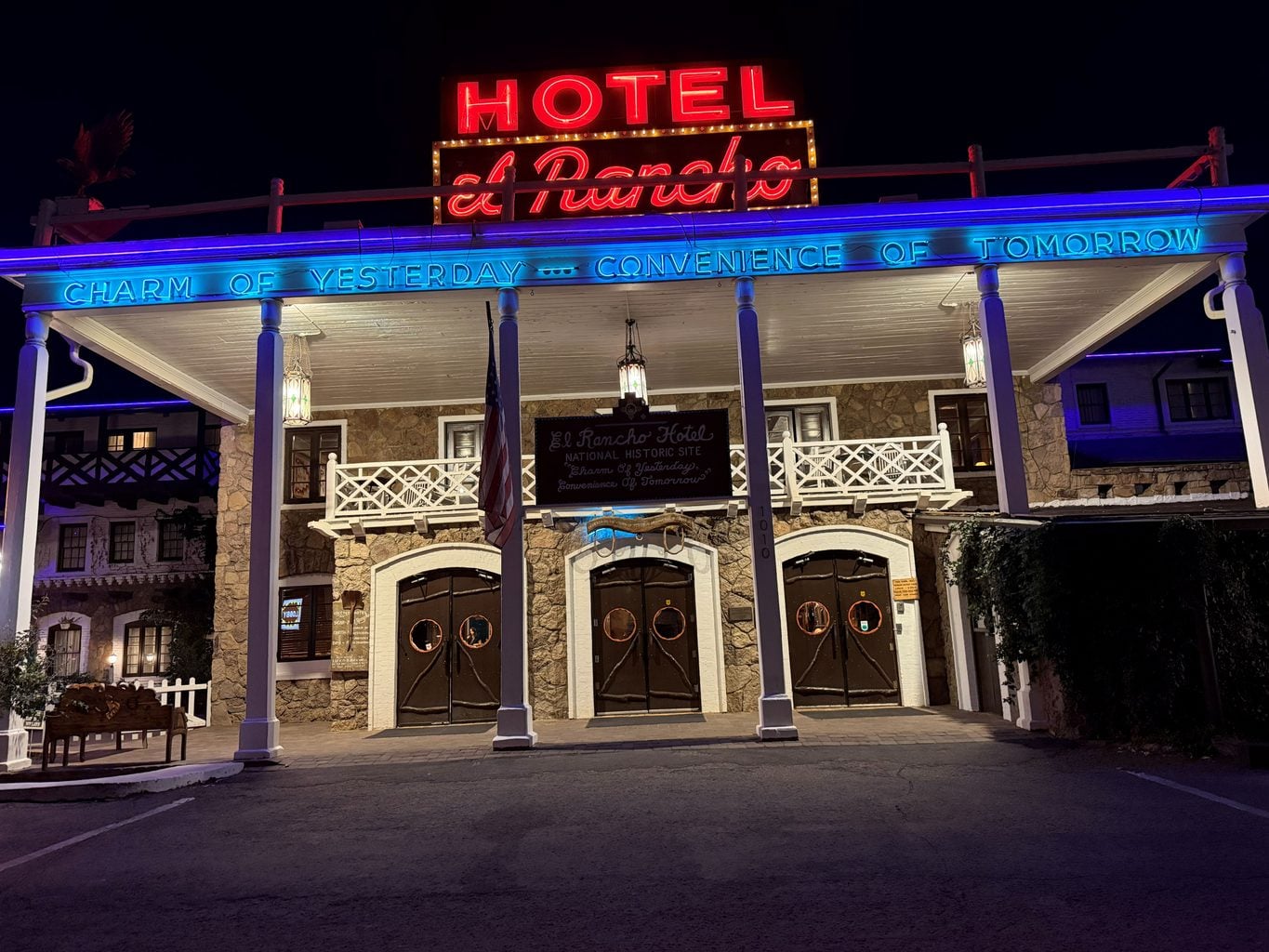
We spent the night at the famous El Rancho Hotel on Route 66 in Gallup. Built in 1937 by R.E. “Griff” Griffith, brother of legendary film director D.W. Griffith, it served as home base for the stars of classic Hollywood westerns filmed in the surrounding desert. Spending a night at this iconic hotel, listed on the National Register of Historic Places, was a true Route 66 highlight.
Day 13: Friday, September 11, 2026
We entered Petrified Forest National Park from the east and stopped at two beautiful Painted Desert overlooks. Formed more than 200 million years ago, layers of siltstone, mudstone, and shale create these eye-candy views. For the geologists among us: iron oxides and hematite create the reds, pinks, and oranges; limonite the yellows and golds; magnetite the lavenders, blues, and grays; manganese the purples and blacks; and quartz the whites.
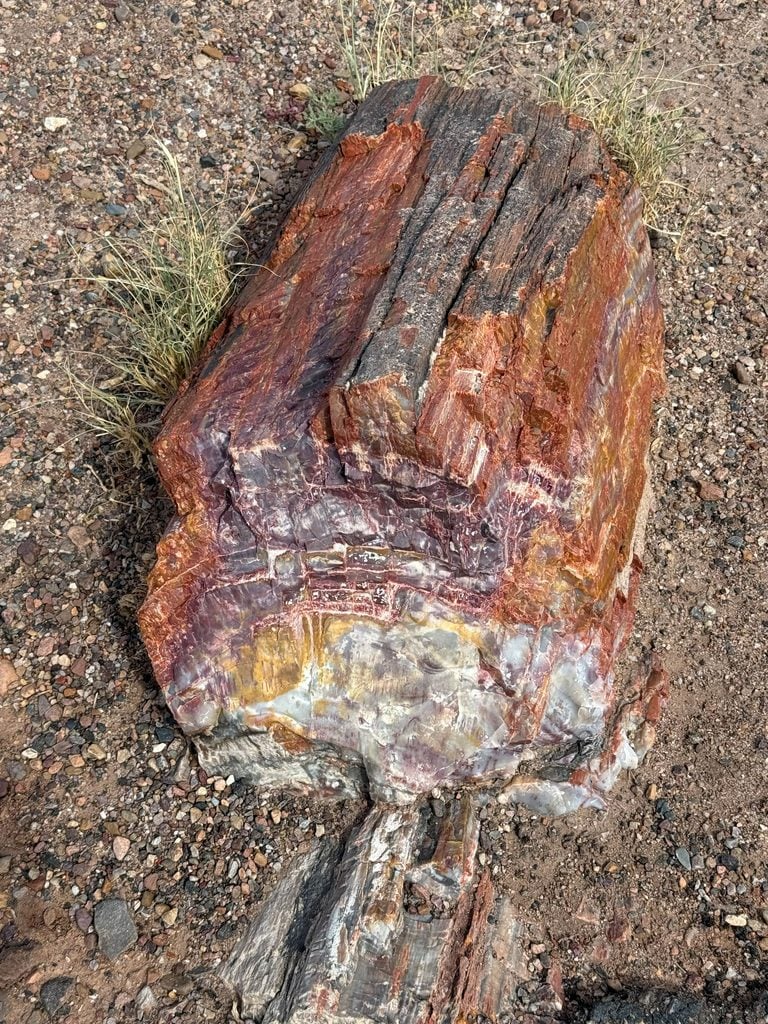
In the Petrified Forest, we stopped at Agate Bridge, a petrified log spanning a deep ravine carved by an ancient river. The National Park Service reinforced it with a concrete base to keep it from eroding further, and guests enjoyed getting up close for photos.
Our final park stop was the Crystal Forest, home to the most abundant petrified wood on the ground. About 25 guests hiked the 0.75-mile loop into the badlands, marveling at how heavy the wood is and photographing pieces of every shape and size.
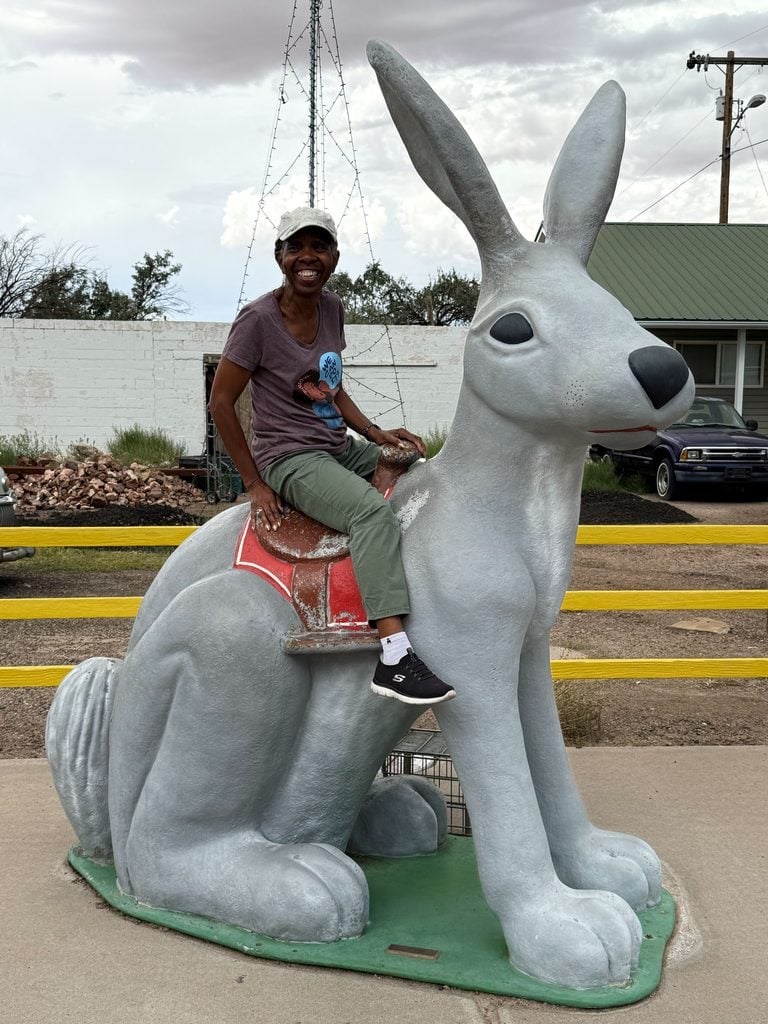
After lunch at Bienvenidos in Holbrook, we visited the Jack Rabbit Trading Post in Joseph City, guarded by its giant fiberglass jackrabbit. Before opening as a trading post in 1949, the building had a colorful past as an Atchison, Topeka and Santa Fe Railway building, a snake exhibit called the Arizona Herpetarium in the 1930s, and later a restaurant and dance hall.
Back on the motorcoach, I played the Eagles’ “Take It Easy” to set the stage for Winslow, where we visited the “Standin’ on the Corner” statues, murals, and flatbed Ford inspired by the 1972 hit.
We spent the night at the Grand Canyon Railway Hotel in Williams, Arizona.
Day 14: Saturday, September 12, 2026
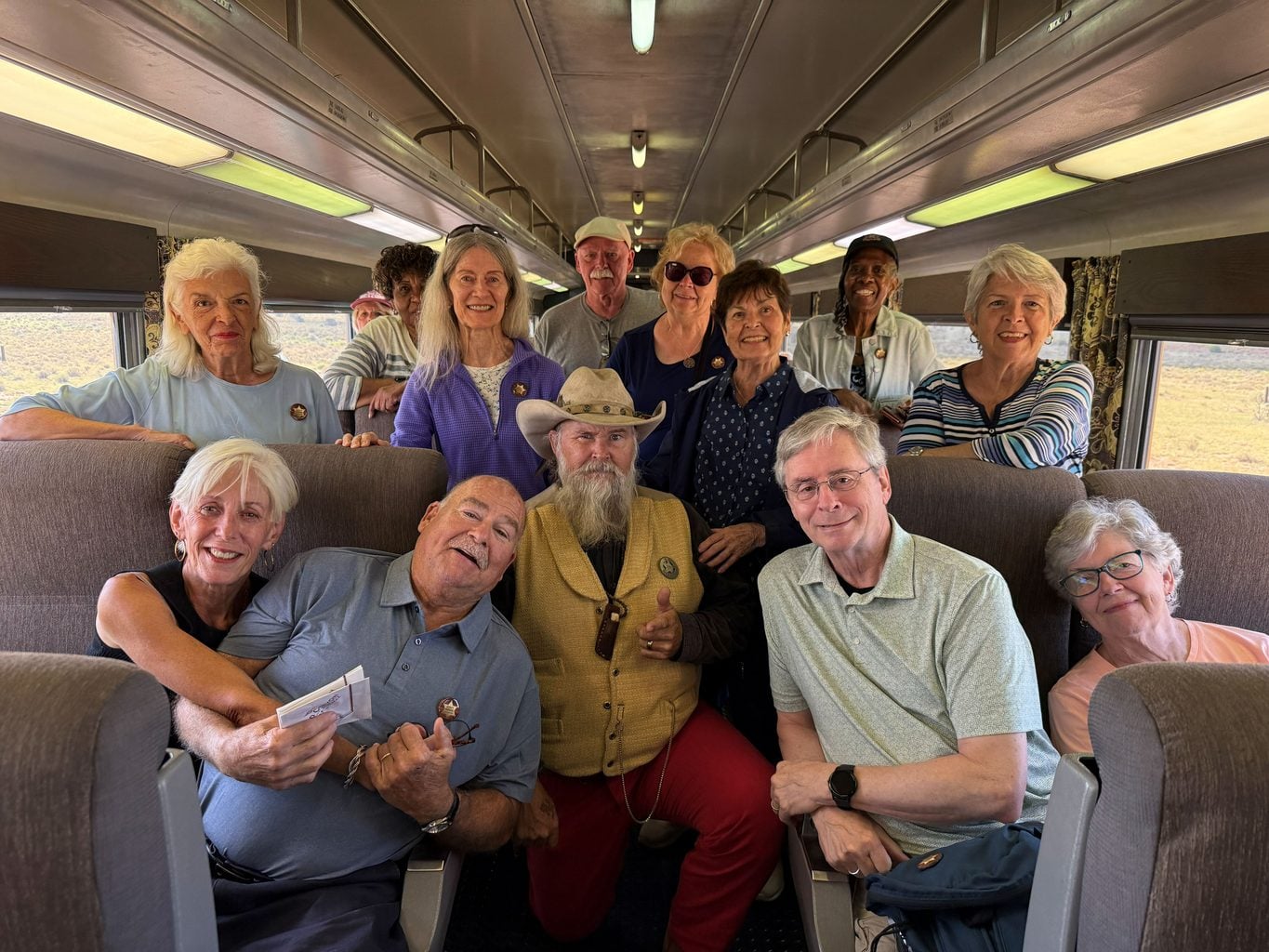
Our Grand Canyon train adventure began with a clever western-style pre-show, complete with a shootout in which the Marshal saved the day. Then we boarded the Grand Canyon Railway for a relaxing first-class ride to the canyon. Along the way, a guitarist serenaded our car, and the Marshal popped in to make sure law and order were being upheld, trading plenty of fun banter with us.
At the Grand Canyon, we climbed 28 steps to the historic El Tovar Hotel, and the breathtaking view came into focus. Brilliant reds, grays, and pinks stretched across the rugged terrain, leaving some speechless, some teary-eyed, and others in complete disbelief. The colors shifted with every angle of the sun and every passing cloud. It was truly a sight to behold!
Some guests hiked a short way down the Bright Angel Trail, where a few came face to face with mules heading down. Others relaxed along the rim and soaked in the views.
On the ride back to Williams, our attendant served snacks and drinks while a guitarist sang, told jokes, and mingled. Then, for a little excitement, train robbers boarded and held us up as we all raised our hands in the air! It was a fun-filled end to a memorable day.
Dinner was at the Fred Harvey Restaurant.
Day 15: Sunday, September 13, 2026
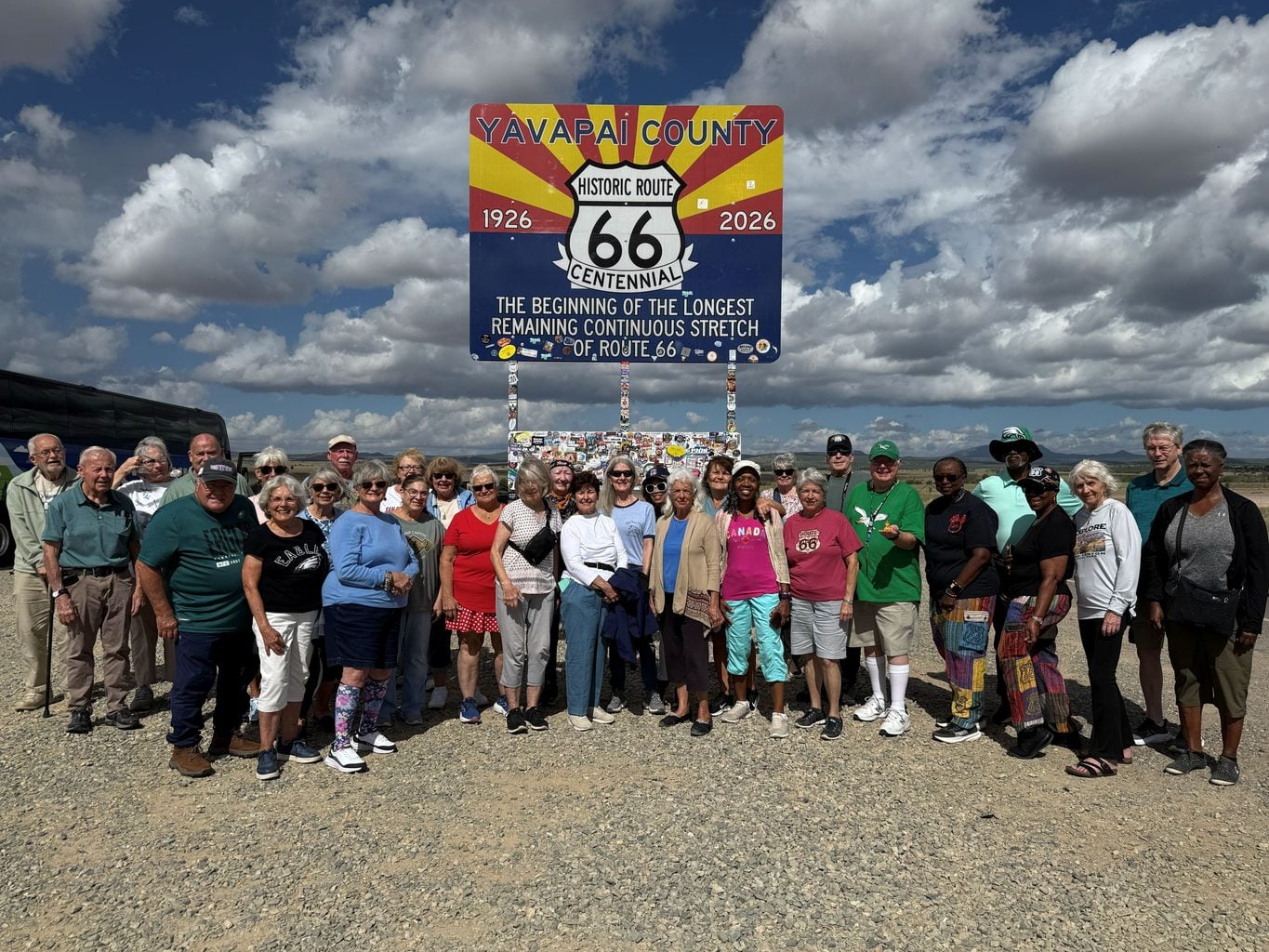
After a stop at the Williams Visitor Center, we traveled Route 66 to Seligman, the town Angel Delgadillo saved after I-40 bypassed it. On the motorcoach, I showed a short video about Angel, who rallied other struggling towns along Route 66 to save the Mother Road. Now 99 years young and doing well, Angel has made Seligman, a town of about 500 residents stretching just over a mile along Route 66, a must-see stop. Angel’s daughter warmly greeted each of us outside the Delgadillo store, and guests enjoyed lunch and found wonderful treasures in the shops. Williams and Seligman truly capture the spirit of small-town Americana.
In Peach Springs, an elevator took us 210 feet underground into Grand Canyon Caverns. Our guide led us along a paved path with handrails, pointing out eye-catching flowstone and colorful formations at every turn. We’re now true spelunkers!
Next came the Hackberry General Store, established in 1934 as the Northside Grocery and Conoco station. Outside, its faded sign, rusted vehicles from 70 to 80 years ago, and old Conoco pumps look like a century-old junkyard. Inside, worn wooden floors, life-sized Elvis figures, and Route 66 merchandise crammed into every corner capture what 1930s travel must have felt like (only with today’s prices!).
In Kingman, the Powerhouse Visitor Center houses an upstairs museum devoted to westward pioneers and Route 66 travel from 1926 to 1940. Highlights include a 1926 car piled high with a family’s belongings, much like the one in “The Grapes of Wrath,” plus exhibits on the Green Book, Williams, Seligman, and Angel Delgadillo, the “Angel of Route 66.” Many guests then strolled to nearby Locomotive Park to climb aboard a giant steam locomotive for photos.
Tomorrow, California, here we come!
Day 16: Monday, September 14, 2026
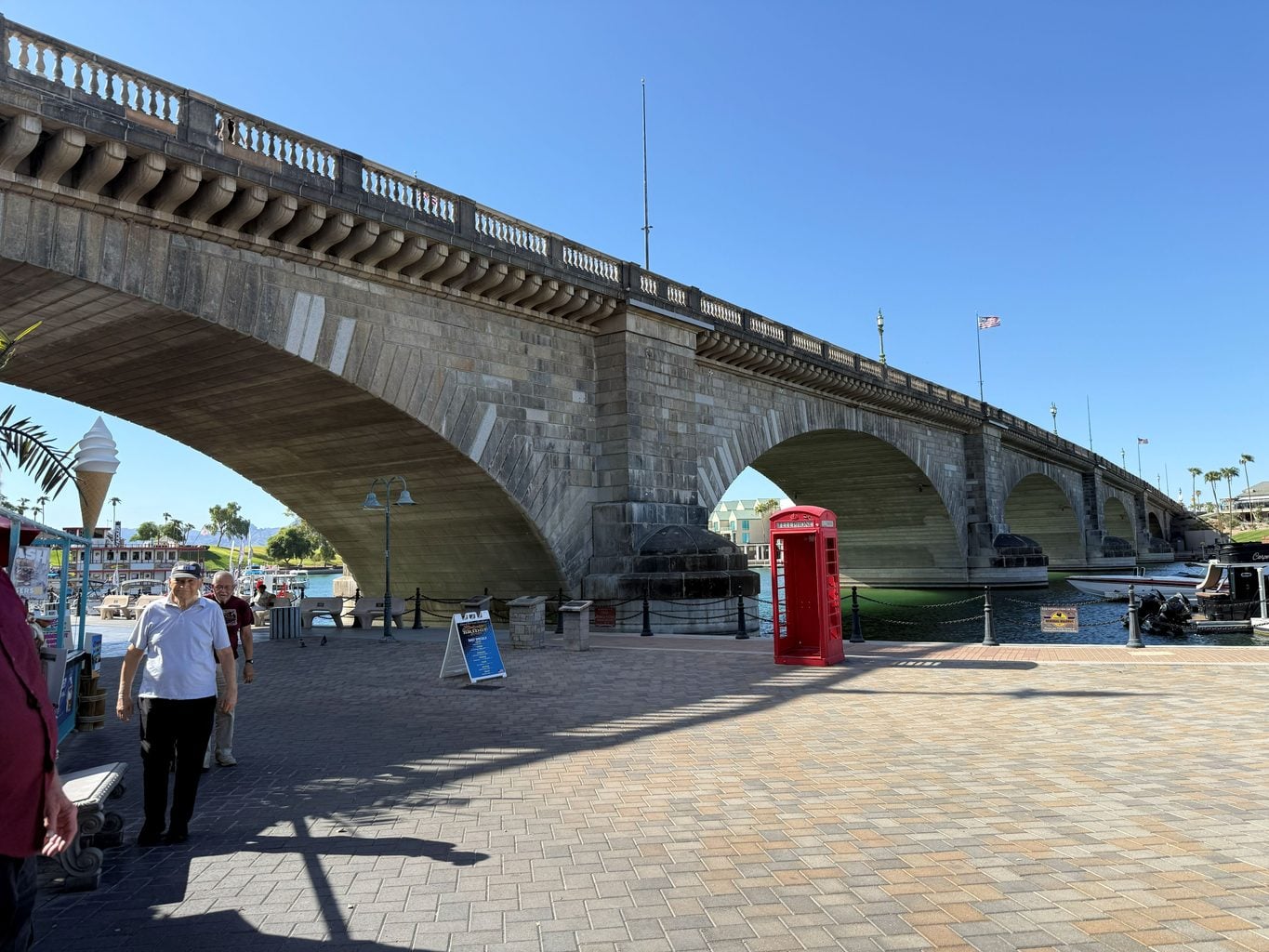
This morning, we departed west to view the Old Trails Bridge in Topock, Arizona before traveling to the London Bridge in Lake Havasu City, Arizona. The London Bridge was purchased from London by real estate developer Robert P. McCulloch in 1968 for $2.46 million as a promotional centerpiece to attract property buyers and tourists to his newly founded desert community, Lake Havasu City. Workers numbered each exterior granite stone before taking the bridge apart in London. Over 10,000 tons of granite were shipped through the Panama Canal to Long Beach, California, and then trucked to Arizona. Rebuilt between 1968 and 1971 over dry land, the original granite blocks were installed. Once assembly was complete, workers dredged the Bridgewater Channel beneath the bridge allowing water to flow underneath the London Bridge once again. Today, the London Bridge is a major tourist attraction with a Visitors Center, restaurants, and a few shops.
After picking up our boxed lunches from Jimmy John’s, we continued west and crossed into CALIFORNIA! Everyone applauded. We made it from coast to coast! The Beach Boys began belting out, “Surfin’ U.S.A.”. After five more California songs, we were traveling well into the Mojave Desert.
I played the documentary titled, “The Harvey Girls”, since we were going to the Harvey House for a tour this afternoon. Fred Harvey, the man responsible for opening food establishments called “Harvey Houses” across the “Wild West” in the late 1800’s, hired single young women as waitresses to calm the male customers. It worked very well and, in an era when it was unusual for women to be hired, it was a proud honor to be hired as a Harvey Girl. The video interviewed actual Harvey Girls and showed historic pictures from the past.
Our next stop was the Route 66 Mother Road Museum. This unique museum displays photos and artifacts from the past 100 years, preserving and displaying the rich history of U.S. Route 66 and the Mojave Desert region. Automobiles from the 1930’s, television sets from the 50’s and 60’s, and a 1950’s kitchen can be found inside. Rooms showcasing photos from the past 80 years provide a wonderful visual of life during the 20th century.
The train museum, located directly next door, is dedicated to preserving the railroading history of the Pacific Southwest. This museum focuses on the crucial role that railways—particularly the Santa Fe and Union Pacific lines—played in opening up the American West and shaping Barstow as a major transportation junction. Outside, full-sized diesel engines, cabooses, freight, and passenger cars sit on railroad tracks. Inside, there is a wide array of railroading memorabilia, including antique train signals, conductor uniforms, railroad lanterns, timetables, tools, model trains, and historic photographs.
To complete this trifecta of museums, we walked into the Harvey House named Casa del Desierto (“House of the Desert”). Designed by renowned architect Mary Colter, the same person who designed the El Tovar and Bright Angel Lodges at the Grand Canyon, the Casa del Desierto was built in 1911 by the Atchison, Topeka and Santa Fe Railway. The current structure replaced an earlier wooden station that was destroyed by fire in 1908. The Casa del Desierto was added to the National Register of Historic Places in 1975.
The lower level of the Harvey House (Casa del Desierto) featured a large room with two fancy chandeliers hanging from the ceiling. The room operated as a restaurant under the Fred Harvey Company with the famous “Harvey Girls” providing fine dining services and hospitality to rail travelers passing through the Mojave Desert. The girls were housed in rooms on the second level while employed.
Following our visit, we arrived at the Holiday Inn in Barstow, California. Everyone was soon settled in their rooms and enjoying their dinner.
Day 17: Tuesday, September 15, 2026
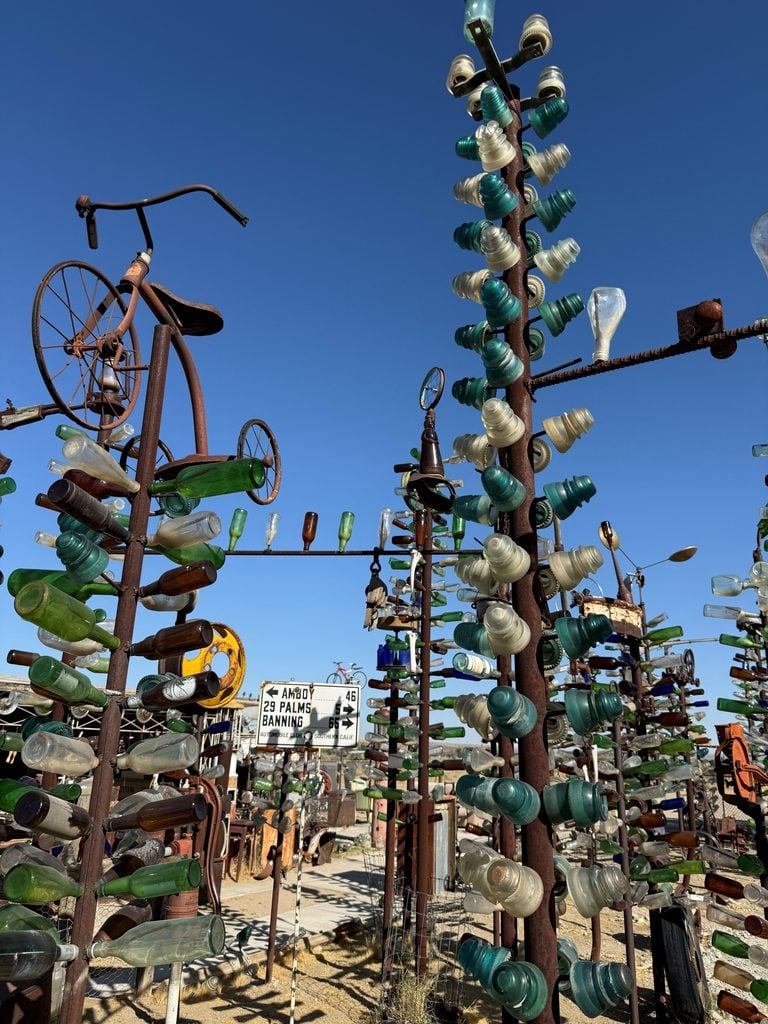
After breakfast, we departed our hotel and traveled to the very quirky Elmers Bottle Tree Ranch on Route 66 in Oro Grande, California. The Bottle Ranch was created in 2000 by Elmer Long, who began collecting vintage glass bottles and relics during Mojave Desert camping trips with his father in the 1950s. After inheriting his father’s extensive collection, he welded pipes to hold the colorful bottles and erected his first “bottle tree.” The 2-acre desert site features over 200 handmade metallic trees decorated with thousands of glass bottles in shades of blue, green, and amber. Unique and unusual tree toppers cap each tree such as old road signs, a traffic light, an electric guitar, a surfboard, farm machinery, and a missile casing.
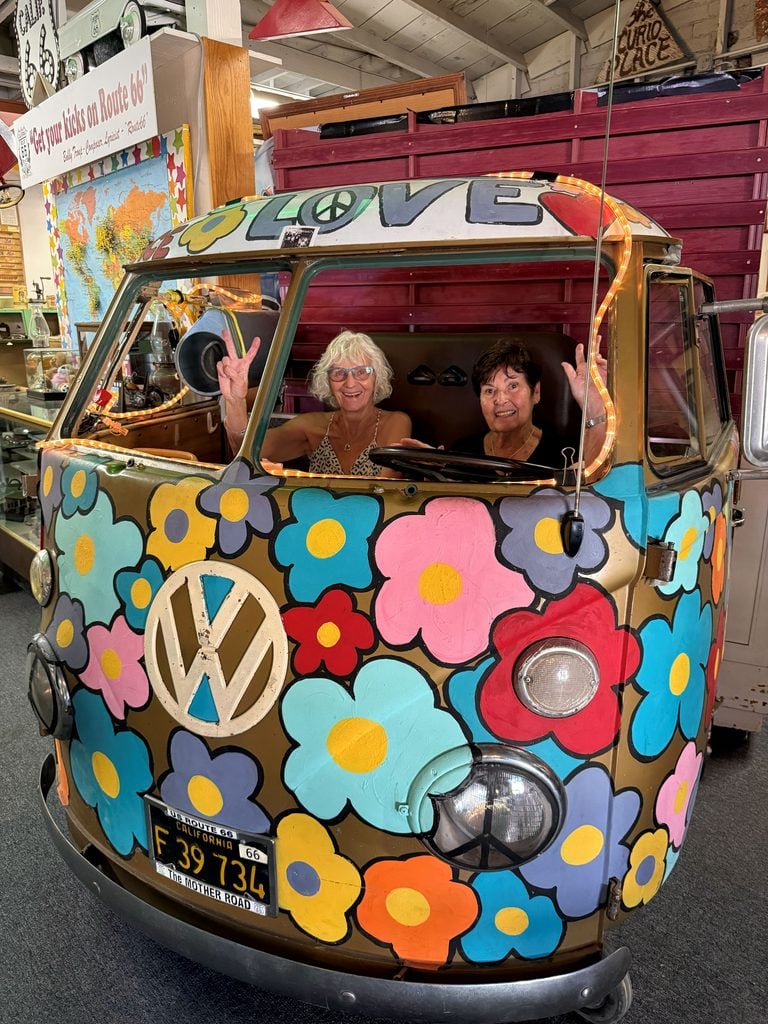
We continued along Route 66 to the California Route 66 Museum in Victorville, California. This interactive museum displays a facsimile “Lovebug,” a yellow Volkswagen Van with “hippies” paint designs from the 60’s in which you could sit inside and pose for pictures. The 1917 Model T Truck is a great photo op. Exhibits explaining the Burma Shave Roadside Advertisements, the life and death of Roy Rogers and Dale Evans, and the influence of the Dust Bowl on Route 66 are scattered throughout the museum. One could sit in a facsimile Route 66 Diner at tables complete with the red and white checkered tablecloth. Many more artifacts and stories line the walls and floor of this unique Route 66 museum.
We traveled 45-minutes into San Bernardino for lunch at Juan Pollo’s. The food began coming out in large tins, including delicious baked chicken, rice, beans, salad, potato salad, and fajitas. The feast could feed 75 people easily! Albert Okura, who founded Juan Pollo, passed away in 2023 at the age of 71. He lived an amazing life. Over four decades, the Mexican-style rotisserie chicken chain expanded to over 25 locations across Southern California, and Okura claimed to have personally cooked over 2 million chickens throughout his career.
In 1998, Okura purchased the historic site of the very first McDonald’s restaurant in San Bernardino, California and established a memorabilia-packed McDonald’s museum that remains a major local roadside attraction. And, in 2005, Okura bought the desert ghost town of Amboy, California, along Route 66 for $425,000 to preserve its history. This included Roy’s Motel & Cafe where we ate our boxed lunches within the Mojave Desert yesterday.
So, after lunch at Okura’s Juan Pollo Restaurant, we traveled to Okura’s original McDonald’s site in San Bernardino for a tour. We were completing Albert Okura’s trifecta of California-owned purchases.
We began our tour by talking about the original McDonald’s sign that sits along Route 66 today. Our guide pointed out a section of the original flooring that was outside on the ground. The museum had pictures spanning from the 1940’s to the 1980’s when the McDonald brothers ran their hamburger stand. Ronald McDonald greeted you upon entering the museum, and artifacts from McDonalds could be seen encased in glass showcases.
We continued traveling into Burbank, California to our hotel, the Hilton Garden Inn Burbank, and settled into our rooms.
Many tour guests boarded the bus at 5:00 PM for dinner, shopping, and entertainment at Universal Studios CityWalk. The CityWalk has a variety of restaurants such as Buca di Beppo, Bubba Gumps, The Chocolate Restaurant, a pizza restaurant, and fast-food choices. The movie, “ET” began showing on the big outdoor screen. Clothing stores, Universal Studios Stores, and sports stores such as “The Dodgers Store” were bustling with customers. The tour guests had a wonderful time walking around, eating dinner, and enjoying this playful environment.
Tomorrow, we conclude our Route 66 experience!
Day 18: Wednesday, September 16, 2026
This morning, Jane Acton, our Los Angeles Tour Guide, met us at the bus and handed out Farmer’s Market maps for everyone as they boarded.
Jane is a wealth of knowledge and enthusiastic about her hometown. She lives in Burbank and knows every street, important building, and many facts of interest from Los Angeles. She not only pointed out Warner Brothers Studios and Paramount Studios, but she told stories about the movies and people that made each successful.
Our first stop was the Hollywood Walk-of-Fame, the TCL Chinese Theater (formerly the Grauman’s Chinese Theater), and the Dolby Theater. This is the “Times Square” of Los Angeles. The TCL Chinese Theater has been converted into an IMAX auditorium that seats 932 people. Originally built in 1927 with 2,200 seats, the seating capacity was reduced during various renovations—most notably in 2013 when the theater was upgraded with stadium seating and one of the world’s largest IMAX screens. Jane led us all around the complex sharing her vast knowledge. The Dolby Theater continues to hold shows and concerts but is best known as the theater that holds The Academy Awards each year. Our group enjoyed taking pictures on the Walk-of-Fame and shopping in the many souvenir shops.
Back on the bus, Jane took us around the streets of Los Angeles, showing us the circular high-rise that is the Capital Records building. She talked about The Comedy Store, located on the Sunset Strip in West Hollywood that opened in 1972. It served as a crucial proving ground where emerging performers developed their routines and got discovered. Some of these comedians included Robin Williams, Jim Carrey, Dave Chappelle, Richard Pryor, George Carlin, David Letterman, Jay Leno, Eddie Murphy, and Roseanne Barr. We rode down Santa Monica Boulevard, the final leg of Route 66, past the Ringo Starr sculpture that he gifted to Beverly Hills, past the Beverly Hills Sign, and into Santa Monica. We had finally reached the Pacific Ocean.
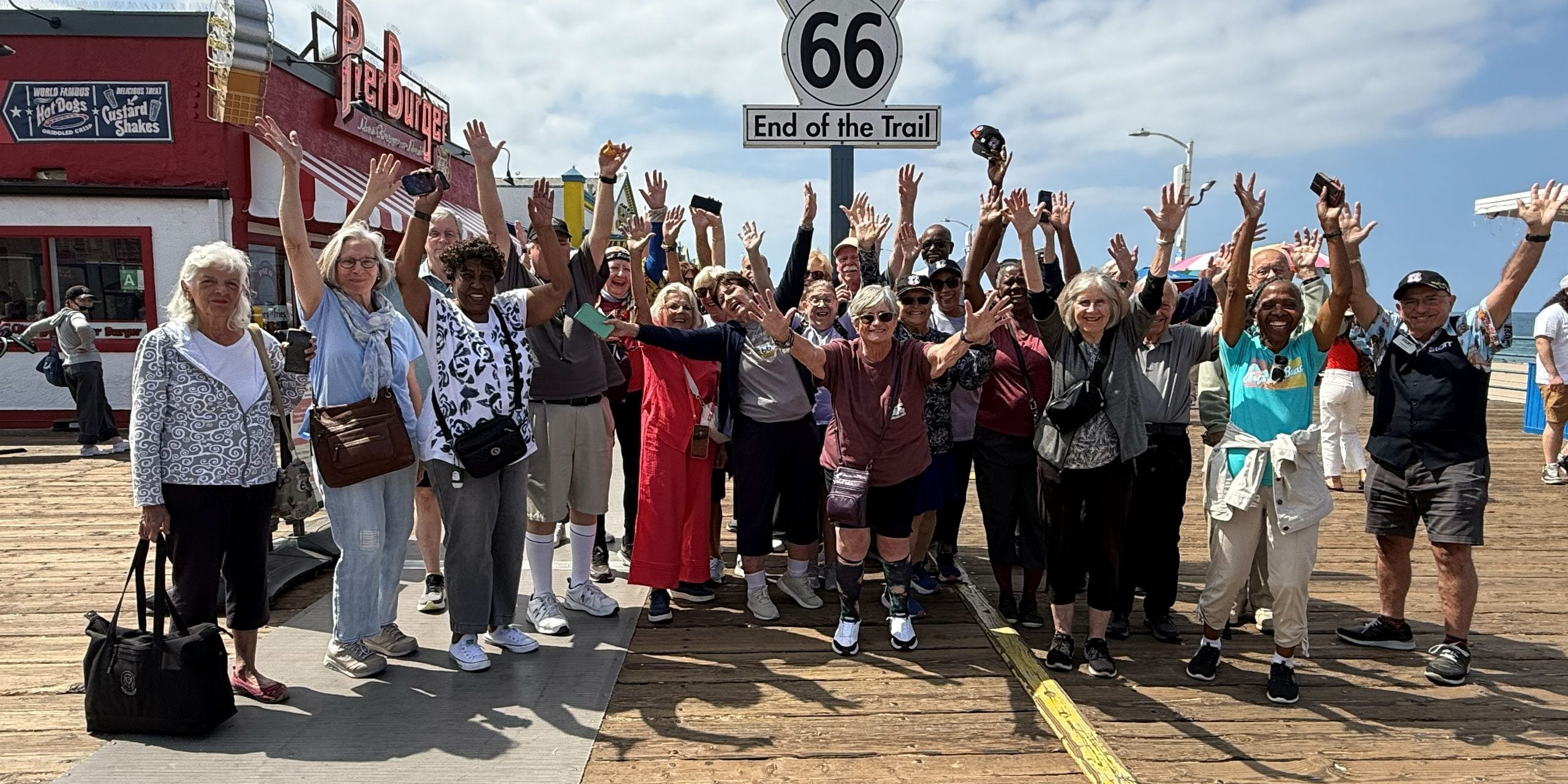
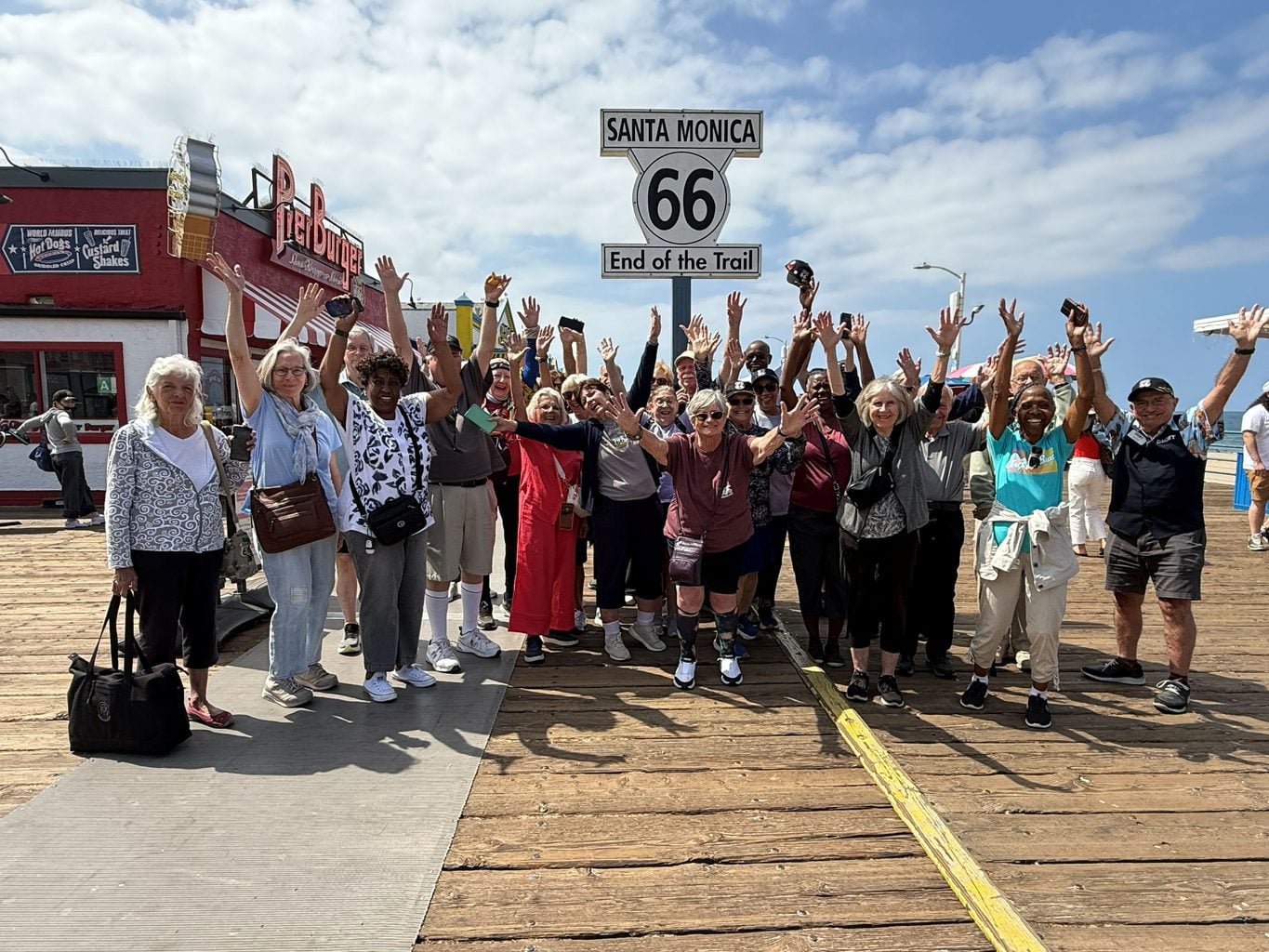
OUR MOMENT HAD ARRIVED! Most of the tour guests followed Jane onto the Santa Monica Pier to “THE END OF THE ROAD” Sign. We had officially completed Route 66. Jane was kind enough to take a group photo. The Pacific Ocean looked beautiful from the Santa Monica Pier. We walked back to the bus extremely proud and with a strong sense of accomplishment!
Our next stop was The Farmer’s Market for lunch. The market opened in July 1934 when a group of a dozen local farmers parked their trucks on a vacant lot owned by A.F. Gilmore to sell fresh produce directly to residents during the Great Depression. Over the decades, the market attracted numerous Hollywood icons. Famous regulars and visitors have included Marilyn Monroe, Shirley Temple, The Beatles, and Walt Disney, who reportedly drew early sketches for Disneyland while sitting at the market’s outdoor tables. One can choose foods from many nationalities and enjoy a meal year-round.
Jane continued our tour, continuing to tell stories, as we rode up the hill to Griffith Park and the Griffith Observatory where the famous Hollywood Sign was clearly visible. We took many pictures of each other, including a group photo with the Hollywood Sign in the background. This was the perfect final stop for our fabulous tour of Los Angeles. Jane was absolutely magnificent and cared so much to provide as many Los Angeles experiences as possible.
Tomorrow, we stop in Vegas for lunch on our way into Utah for the night.
Stay tuned for the group’s journey Eastbound towards home!